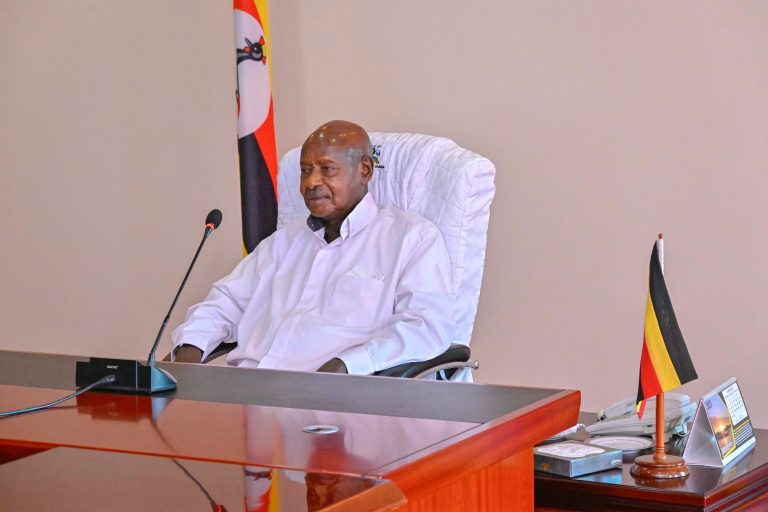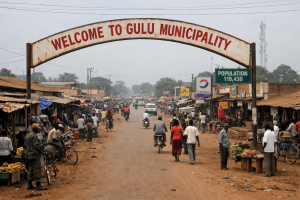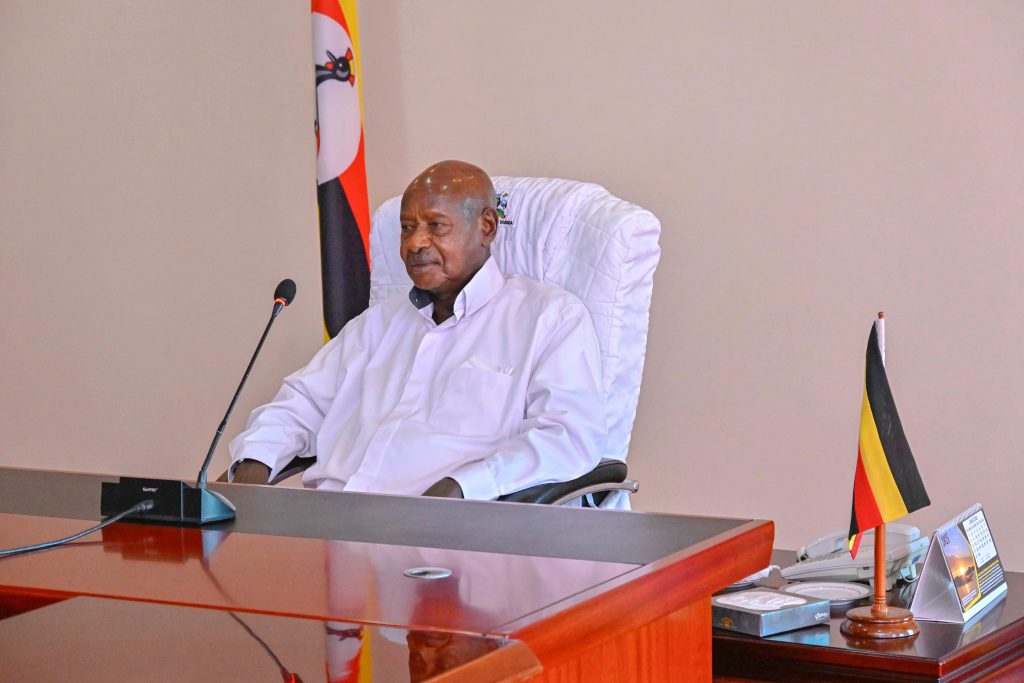
The President’s August 18th meeting in Gulu comes just 6 months before the 2026 general elections. In the eyes of some Acholi political analysts, the timing is not coincidental.
By Willy Chowoo
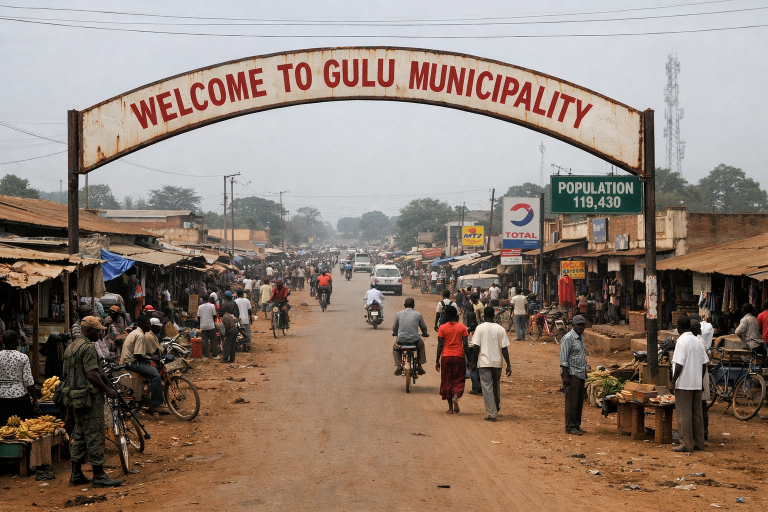
GULU CITY, Uganda — On the morning of August 18, 2025, President Yoweri Kaguta Museveni will step onto the dusty expanse of Kaunda Grounds in Gulu City, the political and cultural heart of Acholi sub-region. The official reason, as contained in an August 13th invitation letter signed by Vice President Jessica Alupo, is clear: to meet leaders over the cattle compensation programme, a flagship government initiative meant to atone for livestock lost during decades of war and insurgency in the sub-region.
But beyond the formalities lies a complex web of history, bureaucracy, politics, and human suffering that has made “cattle compensation” one of the most emotionally charged subjects in Northern Uganda. For many Acholi families, it is not just about livestock; it is about recognition of a wound that has festered for more than three decades.
Officials in the Ministry of Justice and Constitutional Affairs MoJCA say the delays are due to the sheer scale of the programme, the need for cross-checking claims, and budgetary constraints.
They also point to the positive: more than 37,000 claimants across all three regions have now been paid, some for the first time in 40 years, after the government released Sh121.28 billion to MoJCA , of which Sh119.24 billion has already been paid.
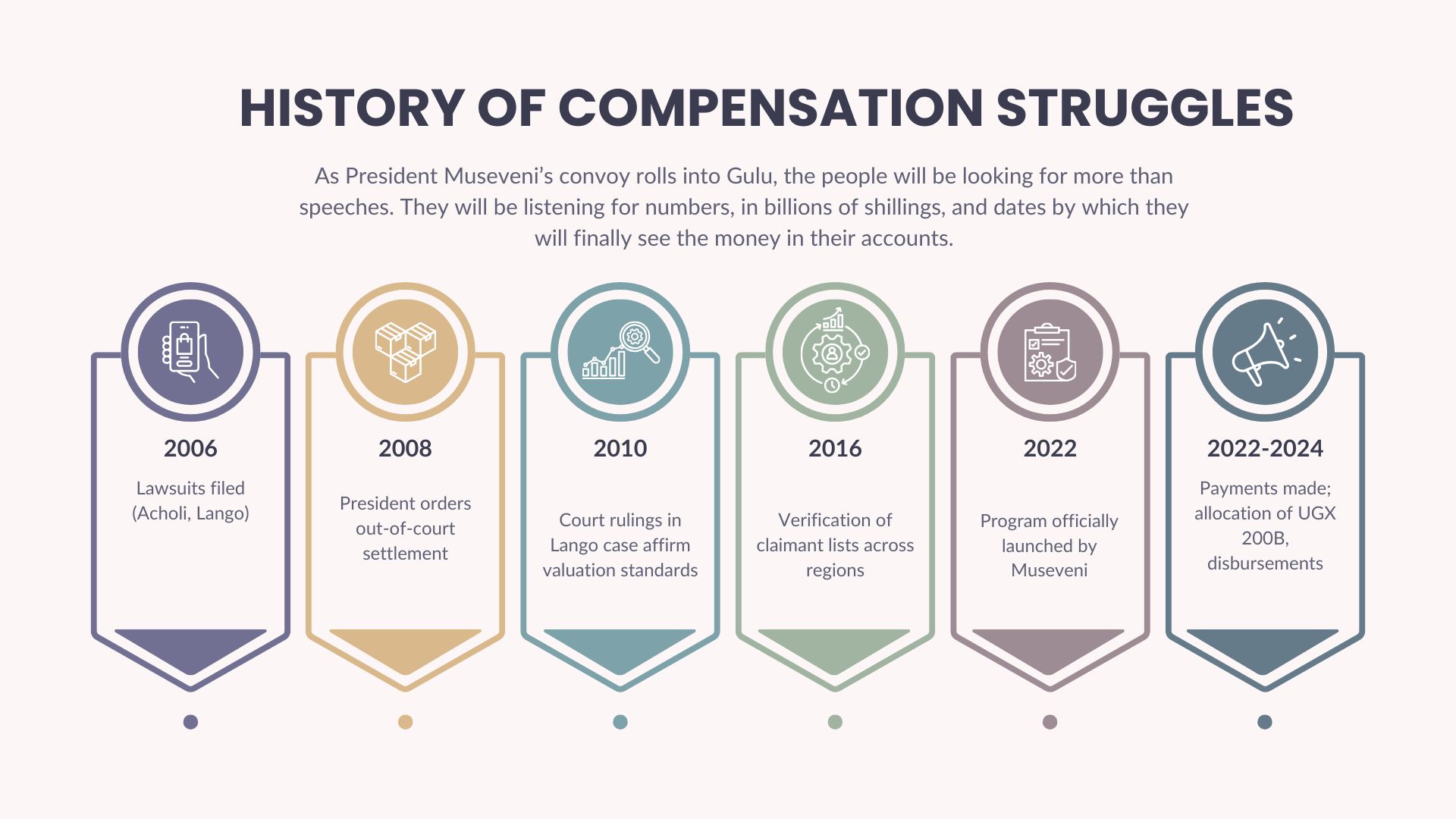
On March 27, 2022, President Museveni officially launched the Livestock Compensation Programme. The event at Soroti University brought together leaders from Acholi, Lango, and Teso to witness the start of payments. This initiative encompassed approximately 92,652 verified claimants across the three regions: 16,946 Acholi, 42,042 Lango, and 33,664 Teso But most of the claimants have not been paid despite allocating billion of money for this scheme.
The compensation compromise followed legal battles in the courts in the case of Acholi and Lango Sub -Regions. In 2006, members of the Acholi War Debts Claimants Association initiated Civil Suit No. 38 of 2006, suing the government over livestock and other losses incurred during the 1985 Bush War and subsequent regional instability
June 2008, President Yoweri Museveni directed the Attorney General to negotiate an out-of-court settlement. He stipulated that negotiations should conclude within six months.
President’s Gulu trip will be after he has done similar meetings in Teso and Lango regions respectively.
A Long Road to Compensation
The Acholi sub-region, comprising the districts of Gulu, Omoro, Nwoya, Amuru, Kitgum, Lamwo, Agago, and Pader, bore the brunt of the Lord’s Resistance Army (LRA) insurgency and earlier cattle raids by government and rebel forces in the 1980s and 1990s. Livestock herds, once the pride and wealth of the people, were wiped out almost entirely.
The government’s cattle compensation programme, launched by President Museveni at Soroti University on March 27, 2022, was intended to address long-standing claims from three war-affected sub-regions: Acholi, Lango, and Teso. Implemented by the Ministry of Justice and Constitutional Affairs, the programme promised cash payments to verified claimants whose livestock was lost to state or rebel forces during past conflicts.
It was billed as one of several “poverty eradication” flagship programmes alongside the Parish Development Model (PDM), Operation Wealth Creation (OWC), and Emyooga.
Yet, for Acholi, the road from promise to payment has been painfully slow. Many have died waiting to be compensated, and those care-taking, getting letters of administration, have been a tag of war. Reawakening the painful war memories and the loss of livestock.
According to parliamentary and ministry reports, Parliament has allocated UGX 200 billion over recent years for war-debt compensation across the three sub-regions. Out of this, the Ministry of Finance released UGX 139.49 billion, and UGX 136.24 billion has been disbursed to claimants.
But those numbers are for all three regions combined. The actual share for Acholi has never been officially isolated in public records, leaving communities here to rely on their district tallies to track progress. But the actual figures documented by Acholi War Debt Claimant Association are at 21,266 people as of Aug 2025.
The Acholi Breakdown
From the most recent verified lists, 16,946 claimants from Acholi have been cleared for payment:
These statistics show a total number of 15,176 claimants out of 16946 that have been verified to be compensated, and only 3870 have received part of their payments.
The livestock valuation used in government computations was UGX 1,050,000 per cow, but because of limited budget releases, payments have often been made pro-rata — meaning many people received less than the value of even one animal.
As of June 30, 2024, official figures show an outstanding liability of UGX 472.72 billion for all three regions. The Parliamentary Public Accounts Committee placed the figure much lower, UGX 208.72 billion, citing discrepancies and verification issues.
Data from the Association indicates that only 3870 have been compensated, amounting to sh4,06 billion, representing only 22.8% of the verified claimants. This means 13,076 are yet to receive their payment.
While no public figure exists for Acholi alone, a proportional estimate based on claimant share suggests the sub-region could still be owed well over UGX 100 billion. For many here, the statistics confirm what they have long believed: compensation has been too slow, too little, and too opaque.
The Acholi War Debt Claimants Association data shows that out of 21,266 claimants, 5,733 members have been omitted from the official list, with 215,733 animals excluded. This omission represents Sh261,519,650 that should have been paid to them.
The data further reveals that 6,227 claimants had the number of their cattle reduced by 229,241 animals in total, translating to a loss of about Sh240 million. As a result, only 5,227 claimants remain eligible to receive a combined payment of Sh158,229,000.
According to the Association’s Chairperson, Oleke Julius, these discrepancies stem from local governments and the Attorney General ignoring the Association’s leadership, which holds authentic records.
“We are working to address this. We are compiling a verified list of claimants—both those still alive and the deceased—while checking active and inactive accounts. We want people to be paid fairly this time,” Oleke noted.
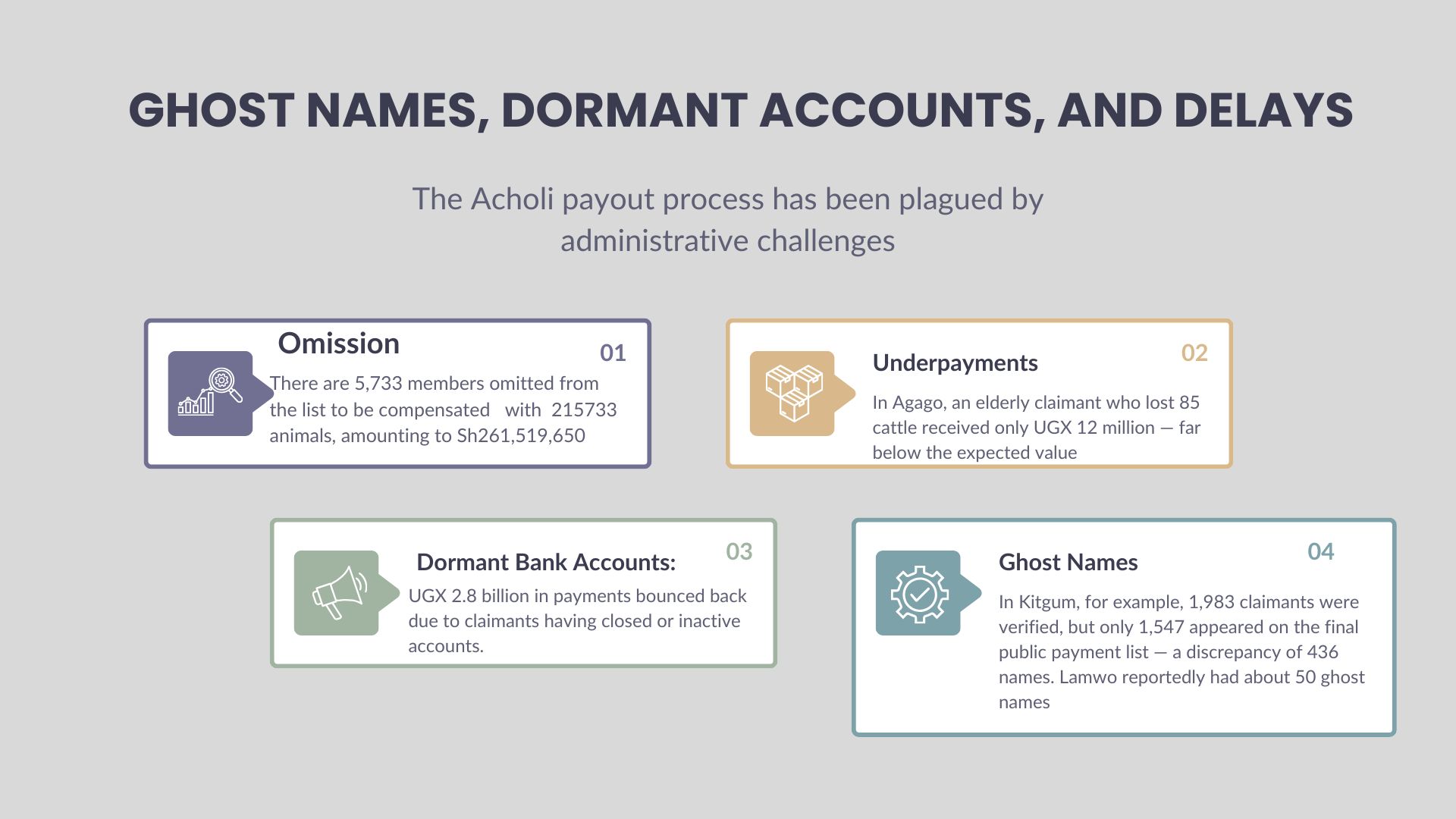
Such issues have fuelled anger and mistrust. Some elders have died before seeing any payment, while others have spent money on repeated verification exercises.
The Politics of Timing
The President’s August 18th meeting in Gulu comes just 6 months before the 2026 general elections. In the eyes of some Acholi political analysts, the timing is not coincidental. The issue of cattle compensation has surfaced prominently in every election season in Uganda, only to fall silent once the polls are over.
“This is an election-season move,” says a Gulu-based political scientist, Okello Anthony. “War-debt compensation has been a long-running grievance, and addressing it, or promising to, can sway voters in a region where the ruling NRM has struggled.” He notes.
To many, it appears to be the usual campaign rhetoric. The meeting is seen as a ploy by the President to consolidate his victory in the Acholi sub-region. In all elections in Uganda since 1996, President Museveni secured a significant share of the vote, with his biggest victory in the region recorded in 2021.
This is something he may wish to reinforce, especially as various politicians are now aligning their support along traditional regional lines in Uganda.
Still, the government insists the meeting is purely administrative. In her letter, Vice President Jessica Alupo describes it as an opportunity to “discuss the success of the programme and adopt measures to accelerate its implementation.”
For Acholi leaders, the President’s visit is a chance to demand clarity and fairness.
Norbert Mao, Minister of Justice and Constitutional Affairs (himself from Acholi), has previously acknowledged the programme’s gaps and called for better record-keeping and timely payments. Local leaders, from MPs to LCIII chairpersons, are expected to attend in large numbers, given the letter’s sweeping invitation to every political and administrative head in the sub-region.
Some leaders are already preparing lists of unresolved cases, underpaid claimants, and communities left out of the process.
Another decisive flashpoint ahead of the 2026 general election is the unresolved eviction of the Balaalo herdsmen from contested land. Two months after President Museveni issued Presidential Order No. 2 directing their immediate removal, implementation remains largely stagnant. Less than half of the herdsmen have vacated, and reports indicate that some are even returning, driving their cattle back onto the disputed land. The government’s slow enforcement and the herdsmen’s defiance are fueling public frustration, particularly among local communities who feel their rights over the land are being undermined. If not urgently addressed, this standoff could escalate into one of the most politically charged and divisive issues on the campaign trail.
In Acholi culture, cattle were not just wealth — they were a bank account, a dowry source, a food reserve, and a community status marker. The loss of livestock accelerated poverty, disrupted marriage systems, and eroded traditional leadership roles.
Economists note that, if valued at today’s livestock prices, Acholi’s total loss could exceed UGX 500 billion. That figure dwarfs the sums allocated so far.
The Kaunda Grounds Moment: A Question of Justice
On August 18th, the meeting at Kaunda Grounds will be both a rally and a reckoning.
For the government, it is an opportunity to showcase progress and promise acceleration. For Acholi leaders, it is a rare moment to speak directly to the President about a grievance older than most of Uganda’s youth population.
The stakes are high. If the President can announce significant new releases of funds — or commit to clearing all verified Acholi claims before the 2026 polls — it could help soften political resistance in a historically opposition-leaning region.
If not, the visit could just as easily amplify frustrations, especially among unpaid claimants.
For Acholi, cattle compensation is not just an economic transaction — it is a test of whether the state can repair the damage it helped cause, directly or indirectly. It is also a measure of whether promises made from the highest office can be honoured in full.
As President Museveni’s convoy rolls into Gulu, the people will be looking for more than speeches. They will be listening for numbers, in billions of shillings, and dates by which they will finally see the money in their accounts.
Even if all verified claimants are paid in the next two years, questions will linger about those left out of verification, those underpaid, and the fairness of valuations. The conversation may also inspire fresh claims from families who feel their losses have never been acknowledged.
But for now, the focus is on Kaunda Grounds. The gathering will be a symbolic chapter in Acholi’s long journey from war to reconciliation, and perhaps, if the announcements match expectations, a turning point in a saga that has stretched across decades and political seasons.