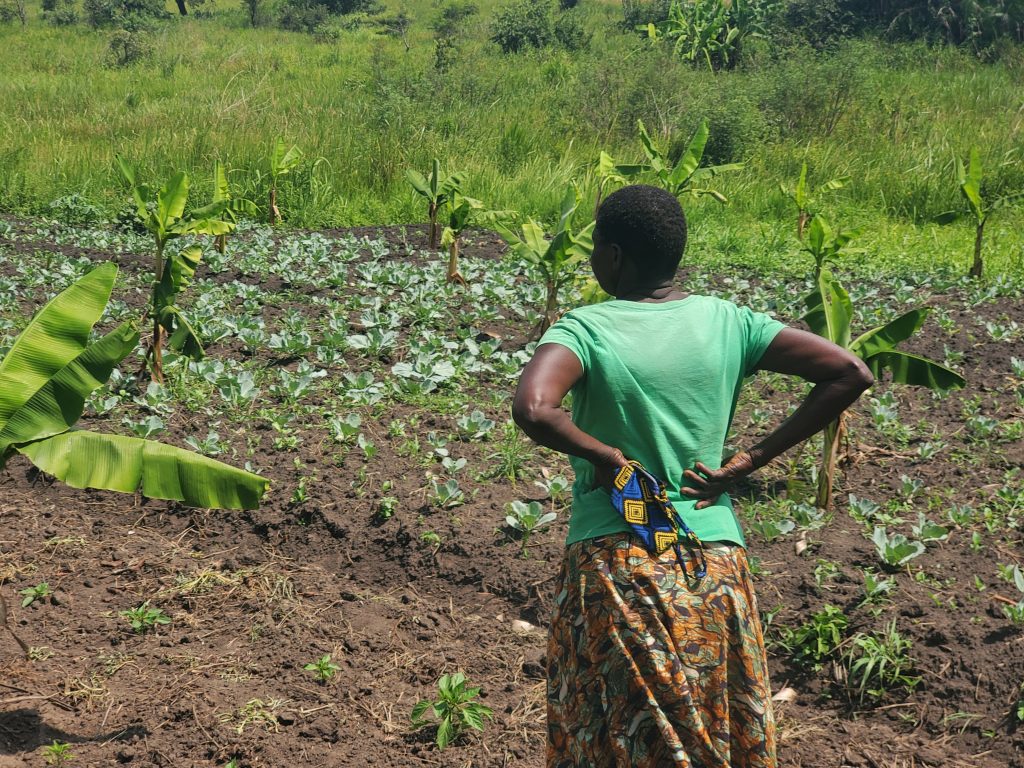
A woman folds her hands behind her back as she looks at her withering crops
The sub-region is battling with one of the longest dry spells ever, which has lasted for close to four months. From March to early July.
By Willy Chowoo | Gulu
At least 15 people have died from hunger-related illnesses in Agago District as a deepening food crisis grips Northern Uganda following prolonged dry spells that wiped out crops across the Acholi sub-region.
The sub-region is battling with one of the longest dry spells ever; it has lasted for close to four months. From March to early July.
More than 350 people—many of them children, pregnant women, breastfeeding mothers, and the elderly—are currently hospitalised in Agago district with malnutrition, with others being acute cases, in the 39 health facilities across the district, local authorities have confirmed.
Out of these, 294 are suffering from moderate malnutrition, 45 from acute malnutrition oedema and 12 from severe malnutrition oedema.
The deaths, recorded within just three weeks between late June and early July, paint a grim picture of a region increasingly vulnerable to climate shocks.
“We have lost around 15 people in our health centres due to malnutrition, and over 350 others are severely admitted,” said Wilson Otto, the Agago District LCV Chairperson. “This is not just hunger—this is a humanitarian crisis.”
Acholi sub-region has two rainy seasons. It runs roughly from late March to November. The first rains (long rains) are from March/April to early June, and the second rains (short rains) are from August/September to October/November.
However, this season, rain returned early in February, and many farmers ignored it as they waited for March, which didn’t register much rain until July.
Omony Williams George, the Weather Forecast Manager at the Uganda National Meteorological Authority, said that only farmers who utilised the early are currently harvesting.
“We always advise farmers to follow the updates we give so that they don’t rely on traditional knowledge of rainfall predictions,” Omony notes.
According to information from the Directorate of Meteorological Services, Ministry of Water and Environment, Northern Uganda is expected to experience near-normal to below-normal rainfall with warmer-than-average temperatures during June-August.
Crops Destroyed, Livelihoods Shattered.
Across the sub-region, several farmers are counting losses as their crops were burnt by the sunshine during the dry spells.
According to district officials, more than 85 percent of gardens were destroyed in Agago district alone during the first planting season due to an extended dry spell, leaving families without both food and seeds for replanting.
“When the gardens are destroyed, they go with the seeds. Many households now don’t even have what to plant when the rains return,” Otto explained.
The district estimates that nearly 80 percent of its 88,000 households are surviving on minimal meals—mainly porridge and boiled pawpaw—signalling severe food insecurity. This leaves only 17,600 households not badly affected.
Agricultural experts and local leaders warn that even if rains resume soon, the hunger situation is likely to persist for at least four months, as crops will take time to mature.
The crisis is also spilling into the education sector. Schools are reporting increased absenteeism and dropout rates as families struggle to provide meals for their children.
“Some secondary schools may be forced to close earlier than planned because parents can no longer afford to contribute food,” Otto said.
For many families, survival has taken precedence over education.
A Regional Crisis Unfolding.
The situation in Agago reflects a broader pattern across the Acholi sub-region, where erratic weather linked to climate change has increasingly disrupted traditional farming cycles.
Agago and Pader are among the most vulnerable districts to dry spells due to their eastern location and proximity to Karamoja; drought impacts are often stronger, but that is not the case this year.
“I have not seen this kind of dry spell in my life, where it doesn’t rain for three consecutive months,” Akello Beatrice Akori, State Minister for Northern Uganda and Rehabilitation, narrates.
In recent years, Northern Uganda has experienced unpredictable rainfall, prolonged dry spells, and declining agricultural yields—conditions that have left subsistence farmers highly exposed.
Most of the small-scale farmers are struggling to adapt to the climate-smart practices as climate shocks continue to hit the sub-region
Previous reporting by The Elephant has highlighted how smallholder farmers in the region are struggling to adapt climate-smart practices, with many suffering heavy losses due to drought and limited access to climate-resilient farming technologies.
Nwoya County member of parliament Opiyo Denis Geoffrey appeals to the farmers to utilise different climate-smart agriculture practices to adapt to an unfriendly climate.
“If our farmers were rearing livestock, it could have helped them, so farmers need to adapt this practice,” Opiyo notes. Adapt
The current crisis underscores those vulnerabilities, as entire communities now face months without reliable food sources.
Urgent Calls for Intervention
District leaders have written to the Office of the Prime Minister (OPM), requesting emergency food relief and support for affected households. They are also appealing to humanitarian agencies, including the World Food Programme, to intervene.
“We are asking for immediate support—food, seeds, and any humanitarian assistance,” Otto said. “If nothing is done, we expect more deaths.”
Minister Akori also raised the alarm, urging the government to respond swiftly to the worsening situation.
“We had a meeting with the prime minister, and we found that they were focusing on the Karamoja sub-region, where 16 people have lost their lives to hunger.” She adds.
Minister Akori has reiterated that the sub-region has lost hundreds of thousands of acres of crops in the first season.
Prime Minister Robinah Nabbanja has indicated that the crisis will be presented before Cabinet for consideration of emergency relief.
With the hope that the rain will return in early August, most farmers don’t have even seeds to plant for the second season.
Minister Akori said they are negotiating with the government through Operation Wealth Creation OWC to distribute seeds to the people of Northern Uganda. The seeds are expected by the beginning of August.
Northern Uganda (West Nile, Acholi, Lang, and Karamoja) has more than 2 million households as per statistics from the national Population and Housing census, 2024 (UBOS). Acholi is the second highest with 466,128 households.
The chairperson of the Acholi Parliamentary Group, Catherine Lamwaka, says they are working with the government to ensure that people are given seeds in the second season
Lamwaka, however, warned farmers against diverting the seeds for something else.
A Race Against Time
Even with intervention, the road to recovery remains uncertain. Farmers must wait for rains, replant crops, and endure months before the next harvest.
For now, communities in Agago—and across Acholi—are bracing for what could be a prolonged season of hunger.
Unless urgent action is taken, local leaders warn, the current death toll may only be the beginning
However, the food nutrition expert has warned that giving relief alone shall not solve the problem of hunger in Agago district. Otim Francis believes the long-term solution is setting up irrigation in the area.
“Farmers can no longer plan a season around the calendar their grandparents used. In that environment, irrigation stops being a development luxury and becomes basic infrastructure, as essential as the road network or the power grid.” He adds.
Otim appeals to the government to trigger a feasibility assessment for irrigation infrastructure, valley tanks, solar-powered boreholes for smallholder schemes, or a formal extension of existing irrigation programmes already piloted elsewhere in Uganda, sited specifically for Agago’s sub-counties