

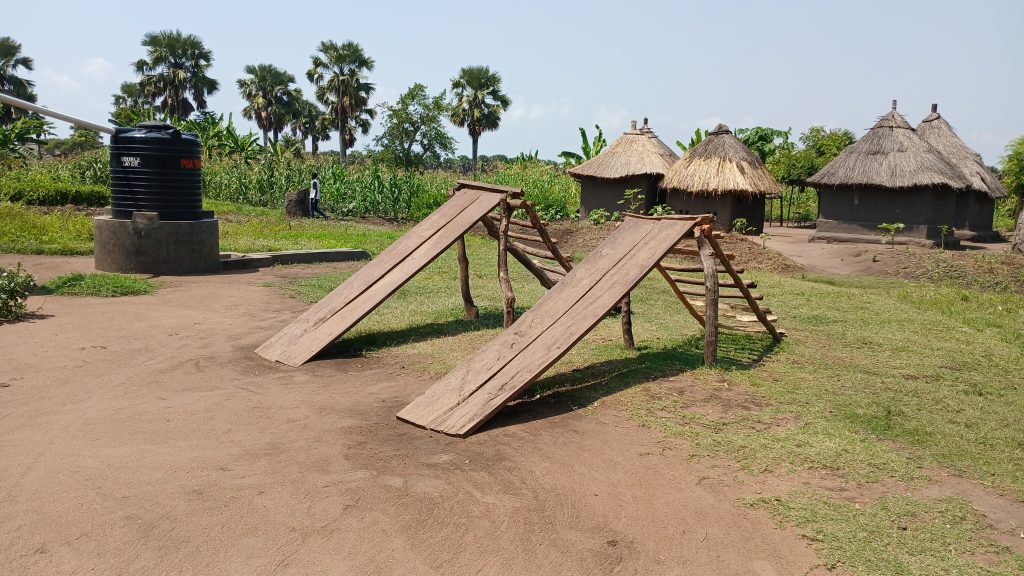
Local slides made out of wood for learners at the home learning center.
There are no colourful concrete buildings, no electricity, and few learning materials; instead, songs, laughter, and the voices of eager children fill the modest structure.
By Teddy Dokotho
Obongi District.
In the scorching afternoon heat of Obongi District, the dusty road leading into Palorinya Refugee Settlement winds through clusters of grass-thatched shelters before opening into Ngun Gwon Koyi Home Learning Centre in Zone 1, Keguin Unit A.
The classroom is unlike the conventional schools found elsewhere in Uganda. It sits within a homestead, built largely by refugee parents themselves using locally moulded bricks and roofed with support from the Local Agency for Development Literacy and Adult Basic Education (LABE).
There are no colourful concrete buildings, no electricity, and few learning materials; instead, songs, laughter, and the voices of eager children fill the modest structure.
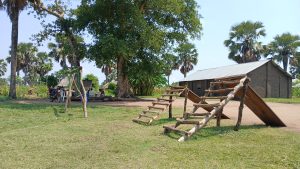
As visitors arrive, a woman hurriedly rushes into one of the classrooms and returns carrying plastic chairs. Within minutes, other parents gather under the shade of a tree. They are not merely spectators in their children’s education; they are the founders, managers, financiers, and, in many ways, teachers themselves.
For hundreds of refugee children in Palorinya and other refugee settlements in Uganda, these community-owned learning centres have become the first stepping stone towards education after fleeing conflict in neighbouring South Sudan.
Education is built from the community
Candia Rhoye, LABE’s Programme Officer for early childhood development in Obongi District, says the organisation deliberately chose a model that places communities at the centre of children’s education.
“These are home learning centres because they are established within people’s homes,” he explains. Adding that
“We first conduct a needs assessment. If the community identifies the need, they organise themselves, elect management committees, and take ownership of the centre. Parents become the leaders while we provide technical support.”
Unlike formal nursery schools, every centre is managed by parents who contribute weekly savings through community groups. Part of the money forms an education fund used to maintain classrooms, purchase locally made learning materials, and provide modest allowances to volunteer parent educators.
Initially, many centres begin under trees.
“When the rains come, churches temporarily provide shelter until the community constructs a permanent structure,” Rhoye says.
The model goes beyond education. LABE encourages every centre to establish income-generating enterprises whose profits help sustain operations long after donor funding ends. Some communities chose poultry farming while others ventured into crop production.
At nearby Belameling Children’s Centre, parents harvested more than 18 tonnes of maize last year. Part of the harvest was used to prepare porridge for children, while the remainder generated income for the learning centre.
At Ngun Gwon Koyi, parents selected poultry farming.
“They have already sold chickens several times; the profits are reinvested into the centre. They use the income to pay parent educators about Shs 50,000 every month, approximately 13 USD,” Rhoye says.
Rather than paying salaries directly, LABE injects revolving capital into community savings groups.
“The capital remains in the group while only the interest is used to support the centers.” It means even when projects end, the community can continue financing children’s education.”
Learning in children’s own language
For many South Sudanese refugee families, one of the programme’s greatest strengths lies in preserving children’s mother tongue.
Moses Lodiong Joel fled Kajokeji in South Sudan before settling in Palorinya with his family. He now has children attending the home learning centre.
“When LABE came, they told us they wanted to teach our children using our own language. We welcomed the programme because many of our children could neither read nor write in Bari,” he says.
Today, his children proudly identify objects around the home using their native language, something he says would have been impossible before joining the centre.
Another parent, Betty Poni Maju, says she has witnessed remarkable changes in the children’s confidence.
“When they return home, they draw pictures on the ground using sticks and name them in our language; they even express their feelings through drawings. The learning centres have also transformed parenting, she says.
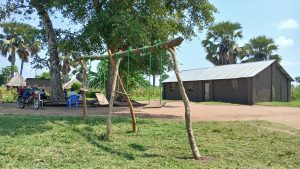
Parents attend workshops where they learn about child development, positive parenting, and how to support learning from home.
“They gave us child albums and trained us on how to use them. They also taught us how to communicate better with our children. The children no longer spend all their time disturbing us at home,” she says with a smile. They continue learning through play.”
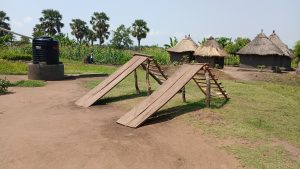
Simple locally made play materials keep children occupied after class while encouraging creativity.
More than ABCs
Inside the classroom, education extends far beyond literacy and numeracy.
Parent educator Edith Kiden begins every lesson with what she calls an “emotional check-in.” Every child is asked a simple question. “How are you feeling today?”
If a child says they are sad, frightened, or hungry, teachers gently explore the reasons before lessons begin.
“Sometimes they tell us they came without eating; we then engage their parents because learning becomes difficult when children are hungry,” Edith says.
Lessons combine emotional development, mathematics, language, literacy, creative play, and free-choice activities tailored to different age groups.
Unlike traditional nursery schools where children are separated strictly by age, LABE uses a multi-age learning model that allows younger and older children to learn simultaneously through carefully designed activities.
A heavy burden on volunteers
Despite the programme’s success, the challenges remain enormous.
At Ngun Gwon Koyi alone, only two parent educators handle approximately 180 learners.
“When one of us is teaching, the others outside may have nobody supervising them,” Edith says.
“There should be more parent educators. The centre also lacks sufficient play materials, classroom carpets, and teaching aids. Children often sit directly on the floor during lessons. “We even bring carpets from our homes,” says fellow educator Betty Poni.
Although communities contribute toward educators’ allowances, the payments are modest.
“The money parents contribute can only buy soap and sugar,” says one parent.
“It is not enough.” Parents hope the government will eventually recognise and support community educators through formal financing and training.
“If government collaborated with LABE, these teachers would be more motivated,” another parent says.
An Inclusive Learning
The centres are also making deliberate efforts to include children with disabilities. Rhoye says parent educators receive quarterly training on inclusive education before every school term.
Children with visual impairments sit at the front of classrooms while learning materials are enlarged to improve visibility. The greatest challenge remains children with mobility difficulties.
Some parents struggle to bring them consistently to school because of distance and caregiving responsibilities.
Nevertheless, educators continue conducting home visits and encouraging families to enroll every child regardless of disability.
Overcrowding threatens quality
Perhaps the greatest obstacle is the growing refugee population. Several centres now enroll between 95 and 125 learners, while others exceed 180 children.
Maintaining quality instruction under such circumstances is becoming increasingly difficult. LABE has proposed introducing morning and afternoon shifts to reduce congestion.
However, doing so would effectively double teachers’ workloads without increasing their already modest allowances.
“Our biggest challenge is the numbers; children continue coming because families see the value of the programme. Rhoye says.
Uganda has earned international recognition for operating one of Africa’s most progressive refugee education systems. Rather than creating separate schools, refugee children are integrated into the national education system under the Refugees Act, the Comprehensive Refugee Response Framework, and the Ministry of Education and Sports’ Education Response Plan.
The policy framework also recognises early childhood development as a priority, acknowledging that young refugee children require education, nutrition, protection, and psychosocial support to recover from the effects of conflict and displacement.
However, implementation remains uneven. Pre-primary education is not compulsory and receives limited government financing, leaving humanitarian organisations, communities, and private providers to shoulder much of the responsibility.
The result is persistent shortages of trained caregivers, classrooms, learning materials, and child-friendly infrastructure across refugee settlements.
Community-led models such as those implemented by LABE are helping bridge this gap, but their sustainability depends on stronger government investment and long-term financing.
The impact is already becoming visible; since extending its home-based Early Childhood Development programme to Palorinya in 2023, LABE estimates that approximately 1,500 children have successfully transitioned into nearby primary schools.
One of them is Winnie Juru; she first attended Belameling Home Learning Centre before joining primary school, where she is now in primary seven. Today, she has returned to serve as a child facilitator, helping younger learners whenever parent educators are unavailable.
“I gained knowledge, skills, and confidence from the centre. I believe I will score a first grade in Primary Seven,” she says.
Her journey captures the quiet transformation unfolding inside Palorinya Refugee Settlement.
Healing young minds through play
Beyond teaching children to count, read, and write, early childhood education is helping refugee children recover from the invisible scars of conflict.
Research shows that the first eight years of life are the most critical period for brain development. According to the United Nations Children’s Fund (UNICEF), more than 90 per cent of a child’s brain develops before the age of five, with more than one million new neural connections forming every second during the early years.
These neural connections form the foundation for language, memory, emotional regulation, learning, and social skills. Responsive caregiving, play, good nutrition, and quality early learning help shape this brain architecture, influencing a child’s health and opportunities throughout life.
The World Health Organisation (WHO), UNICEF, and the World Bank further note that nurturing care, including adequate nutrition, health care, safety, responsive caregiving, and opportunities for early learning, is essential for healthy child development.
Children who grow up without these experiences, particularly those exposed to conflict, displacement, or chronic stress, face an increased risk of delayed cognitive, emotional, and social development.
For refugee children, play-based learning provides far more than classroom activities. UNICEF says structured play creates predictable and safe environments where children can rebuild trust, process traumatic experiences, and develop resilience.
Children who miss quality early childhood education are more likely to begin primary school without basic literacy, numeracy, and social-emotional skills, increasing their risk of poor academic performance, repetition, and eventually dropping out of school, according to the Centre on the Developing Child at Harvard University.
Government officials say these benefits are increasingly evident in Uganda’s refugee settlements.
The Office of the Prime Minister’s Refugee Desk Officer for the West Nile Region, Solomon Osakan, says community-based home learning centres are playing a vital role in helping refugee children overcome trauma.
“These centres are healing refugee children; many of these children have experienced traumatic events. Through play, interaction, and learning, they gradually regain confidence and begin to socialise again,” he says.
Solomon notes that while Uganda previously had no formal policy framework supporting early childhood development, the government now recognises the importance of early learning and has focused on supervising ECD programmes implemented by partners and communities.
He, however, believes greater investment is still needed.
“These are already established learning centres; what communities need is more support to maintain them, improve sanitation, and provide basic services because these children are still very young.”
Nutrition remains another major challenge.
Solomon recalls visiting an ECD centre in one of the settlements where children left their classrooms to look for porridge elsewhere.
“There should be meals provided at these centres, even something as simple as porridge would improve attendance and learning. In one of the centres, we found children crossing to another learning centre simply because it was serving porridge.”
His observations mirror the experiences of caregivers working directly with refugee children.
At United Home Learning Centre in Bidibidi Refugee Settlement, caregiver Isaac Lokiko says hunger continues to interrupt learning.
“Towards break time, many children begin to fall asleep because they have not eaten,” he says.
Since the learning centre is located within the community, many parents take their children home during break so they can eat before returning for afternoon sessions.
Despite these challenges, Lokiko says the community continues looking for solutions. With support from LABE, the centre has established a school garden, complete with nursery beds, to improve food production and eventually supplement children’s meals.
The resilience fostered through these centres is perhaps best illustrated by Kojo Joy, now 13 years old and in Primary Five. Having started her education at one of the home learning centres, she is among hundreds of refugee children who have successfully transitioned into formal primary education, demonstrating how investing in children’s earliest years can create opportunities that extend far beyond the classroom.
In classrooms built from mud walls and community determination, refugee parents are proving that education does not always begin with expensive buildings or government payrolls.
Sometimes, it starts with neighbours coming together under a tree, contributing a few shillings each week, and believing that every child, regardless of displacement, deserves the chance to learn, dream, and build a better future.
As conflict and displacement continue to uproot millions of children across the world, the story unfolding in Uganda’s refugee settlements offers an important lesson: childhood cannot wait.
Governments, development partners, and humanitarian agencies must invest more in Early Childhood Development by training and paying caregivers, expanding learning spaces, providing nutritious meals, and equipping centres with adequate learning materials.
Investing in a child’s first eight years is not merely an educational intervention; it is an investment in peace, resilience, and the future. For refugee children who have already lost so much to conflict, protecting their right to play, learn, and thrive may be the most powerful step toward rebuilding lives and breaking cycles of poverty and displacement.



One Response