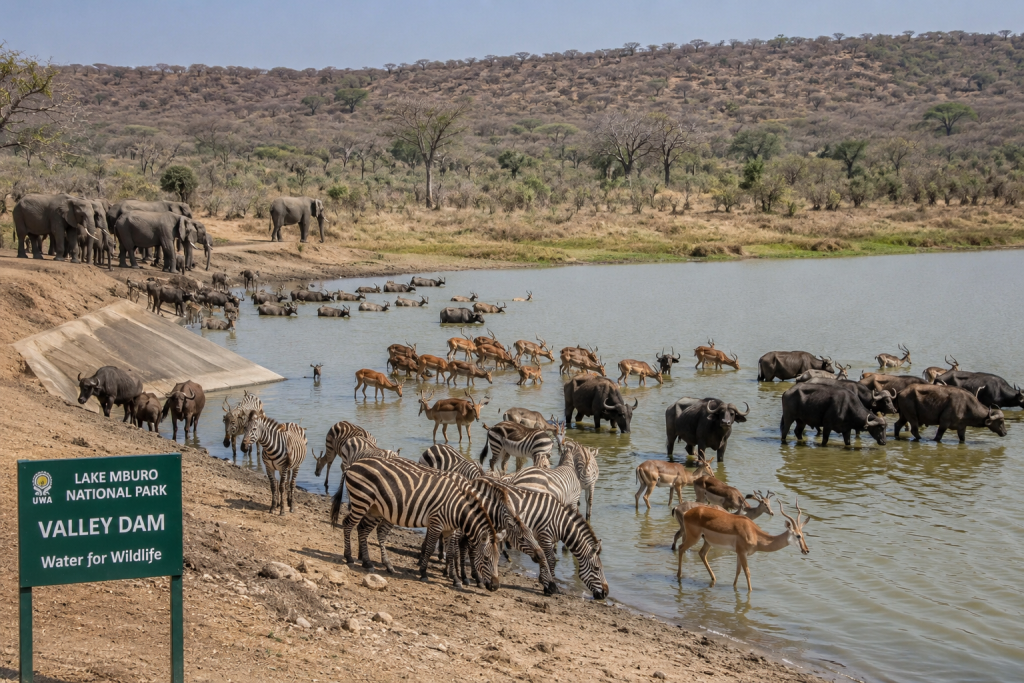
An AI-generated image of a valley dam at Lake Mburo National Park.
To address the growing water crisis, UWA has scaled up the construction of valley dams—man-made reservoirs designed to trap and store rainwater for use during dry periods
By Willy Chowoo
Nwoya District.
As climate change tightens its grip on Uganda’s protected areas, the Uganda Wildlife Authority (UWA) is turning to a simple but effective solution—valley dams—to keep wildlife alive through prolonged dry spells.
Uganda’s protected areas are increasingly feeling the strain of climate change, with prolonged dry spells and erratic rainfall disrupting ecosystems that wildlife has depended on for decades. What were once predictable seasonal patterns are now shifting, leaving conservation managers scrambling for solutions.
John Makombe, the Uganda Wildlife Authority (UWA) Commissioner for Biodiversity and Wildlife Management, says declining rainfall is triggering a chain reaction across ecosystems.
“Less rain increases temperatures and alters seasons, forcing wildlife to migrate in search of water,” Makombe explains. “Climate change is now a major factor influencing how animals are distributed within ecosystems.”
These shifts go beyond animal movement. Makombe notes that entire landscapes are gradually transforming—from open savannahs to woodlands and even forests—leading to changes in vegetation and wildlife species composition.
At Murchison Falls National Park, Uganda’s largest park, the savannah grassland is turning into woodland; the Borassus palm is turning the area into a woodland.
The Conservation Chief Warden, Fredrick Kiiza, says the rapid shift is making wildlife go to other areas. “When this happens, animals are forced to migrate because the food they rely on disappears.”
Mr. Kizza explains that both alien and indigenous plants that have become prolific are transforming savannah grasslands into woody landscapes

“For those who have been here before, succession is taking place inside MFCA, where Savannah is turning into woodland due to the impact of climate change,” he notes.
The movement of animals outside has been a major challenge across Uganda’s protected areas, with communities bordering Kidepo Valley, Queen Elizabeth, and Murchison Falls National Parks.
There have been reports of frequent incidents of crop damage, human scare, livestock predation, occasional human injury or loss of life, and infrastructure damage.
According to the State of Wildlife Resource Report 2026, the Uganda Wildlife Authority recorded over 6,100 conflict incidents between 2020 and 2025.
Crop damage accounted for approximately 5,429 of all reported cases, followed by human scares (183), human injuries (122), livestock predation (122), and infrastructure damage (244).
Drought, dying grass and wildlife stress
The immediate impact of these changes is visible on the ground: drying grasslands, shrinking water sources, and rising pressure on wildlife survival.
UWA Executive Director Dr. James Musinguzi says extreme dry conditions are among the most pressing threats facing Uganda’s national parks today.
“Our parks are being affected by climate change and extreme dry conditions, which cause the grass to dry up,” he says. “This creates multiple challenges, including limited food and water for wildlife.”
In such conditions, animals are forced to travel longer distances in search of water and pasture, exposing them to exhaustion, starvation, and even death. In some cases, they stray into neighbouring communities, increasing the risk of human-wildlife conflict.
In 2023, UWA registered 6,999 human-wildlife conflict incidents reported across the country, which was a reduction from 7,861 cases recorded in the Financial Year 2021/2022.
Musinguzi adds that climate extremes are not limited to drought. Flooding in other seasons also disrupts habitats and infrastructure, making park management even more complex.
In 2022, flooding displaced hundreds of Nile Crocodiles at MFNP; the sandbags where they lay their eggs were washed away, and a number of them died. As of 2023, the population of the Nile crocodiles was about 1000.
Sinking Valley dams.
To address the growing water crisis, UWA has scaled up the construction of valley dams—man-made reservoirs designed to trap and store rainwater for use during dry periods.
“We are sinking valley dams to ensure animals have enough water for their welfare,” Musinguzi says. “This is part of our broader strategy to mitigate the effects of climate change.”
These dams are strategically located within protected areas to reduce the distance animals must travel in search of water. By keeping wildlife within park boundaries, the dams also help minimise conflict with surrounding communities.
In Kidepo Valley National Park, one of Uganda’s driest conservation areas, UWA has already constructed six valley dams. The park, known for its harsh climate, regularly experiences prolonged dry spells that threaten wildlife survival.
The dams now act as critical water points, sustaining animals during periods when natural water sources dry up.
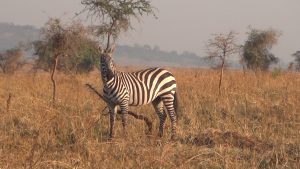
At Lake Mburo National Park, the impact of drought has historically been severe, affecting both vegetation and wildlife populations.
Fredrick Wanyama, Chief Warden of the Lake Mburo Conservation Area, explains that rising temperatures accelerate water loss and degrade grazing conditions.
“When temperatures rise, there is significant water loss to the atmosphere, and the soil becomes stressed,” he says. “This leads to vegetation change and the emergence of species that are not palatable to wildlife.”
As nutritious grasses decline, animals are forced to move further in search of food and water. Some leave the park entirely, while others attempt long treks toward Lake Mburo itself—journeys that can prove fatal.
“We have seen animals die along the way because of the long distances they have to cover without water,” Wanyama notes.
To counter this, UWA has constructed 12 valley dams across the Lake Mburo landscape. These reservoirs provide reliable water sources during the park’s two main dry seasons—January to March and June to December.
“With valley dams, water is now readily available within the park,” Wanyama says. “This reduces animal movement, prevents deaths, and helps stabilise the ecosystem.”
Restoring ecosystems.
Valley dams are only one part of a broader conservation response. Uganda Wildlife Authority is also actively managing vegetation to improve grazing conditions.
In Lake Mburo conservation area, invasive and less palatable plant species are being removed to allow nutritious grasses to regenerate. This intervention is already helping to restore feeding grounds and attract wildlife back into safer areas of the park.
“When we remove problematic species, we increase forage for wildlife,” Wanyama explains. “We are now seeing animals return because conditions are improving.”
In the financial year 2022/2023, UWA removed a total of 2,220.1 hectares of invasive species across the protected areas, with almost half of them from Lake Mburo National Park. They cleared 1,013.2 hectares (45.6%) of Acacia at Kizimbi, Nshara, Kanyinashara and Rwonyo
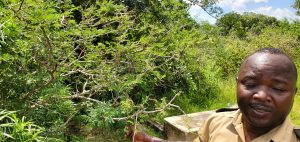
Meanwhile, the authority at MFNP has launched a large campaign to remove 10,000 hectares of invasive species. To date, they have restored 1,500 hectares that were previously invaded by the fast-spreading invasive plant species.
Such integrated approaches—combining water provision with habitat restoration—are proving critical to adapting to climate change. This is why the country has continued to record an increase in the number of tourists in most of the protected areas.
Conservation, security and tourism are at stake
The stakes extend beyond wildlife survival. Tourism remains one of Uganda’s key economic drivers, and healthy ecosystems are central to attracting visitors.
Musinguzi warns that climate change, if left unaddressed, could undermine the sector.
“In the long run, these effects impact tourism,” he says. “People come to see animals, so we must ensure the conditions support wildlife.”
Uganda has been recording an increase in the number of tourists over the past few years. In 2025, international visitor arrivals climbed to more than 1.6 million, and tourism earnings surged to UGX 5.8 trillion (about USD 1.62 billion).
The Authority is also investing in infrastructure such as bridges to maintain access for patrol teams during extreme weather. This ensures that law enforcement operations continue even when flooding or drought disrupts movement.
This adds to the existing road networks within the protected areas. At Murchison Falls NP, more than 111 km of road has recently been tarmacked by the government.
They have also worked on the Paraa bridge (Tangi Gate) connecting to Masindi, Nwoya, Anaka, Buliisa, Nebbi, and Pakwach, which has been constructed to ease access between the north and south banks of the River Nile daily as opposed to a ferry.
Without such measures, conservation efforts could be compromised, creating opportunities for illegal activities within parks.
A race against a warming future
As climate patterns continue to shift, the pressure on Uganda’s protected areas is expected to intensify. Longer dry spells, unpredictable rains, and changing ecosystems will require sustained adaptation.
Valley dams, though relatively simple in design, are emerging as a critical tool in this fight—helping to secure water, stabilise wildlife populations, and maintain ecological balance.
For UWA, the challenge now is scaling up these interventions while integrating them into long-term conservation planning to address the effects of climate change.
“We must continue working hard to address the effects of climate change,” Musinguzi says. “It is essential for wildlife, for tourism, and for the future of our protected areas.”
In the face of a warming climate, the quiet pools of water held behind valley dams may well determine the survival of Uganda’s wildlife—and the resilience of its conservation efforts.
Uganda Wildlife Authority is enhancing the integration of monitoring mechanisms, scaling progress on ground-based and technology-assisted surveys
UWA ED Dr. Musinguzi explains that it will improve habitat restoration and the management of invasive alien and problematic native plant species.
They also plan to boost data integration across institutions to incrementally close knowledge gaps, especially for the neglected, under-studied taxa and wildlife in non-protected areas.