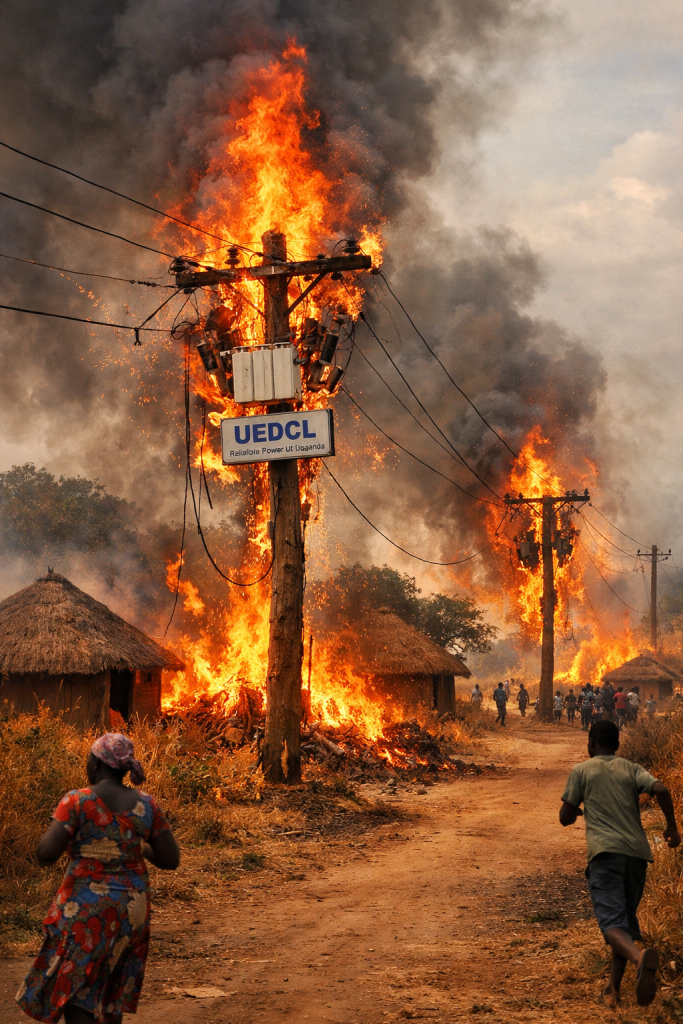
UEDCL warned that bush burning around electricity infrastructure is not just destructive but illegal. Under the Electricity Act (Amended) 2022, CAP 157, destruction or vandalism of electricity infrastructure attracts severe penalties.
By Willy Chowoo | The Elephant
Uganda Electricity Distribution Company Limited (UEDCL) has launched an intensive community engagement campaign in northern Uganda, warning that widespread bush burning is destroying electricity infrastructure and worsening power outages across the Acholi sub-region.
Speaking in Gulu City during a media engagement on Tuesday, Jonan Kiiza, UEDCL’s Head of Corporate and Stakeholder Affairs, said the utility has recorded at least 47 electricity structures destroyed by bushfires in Acholi and part of the Madi subregion, with the worst-hit areas being Adjumani, Amuru, and parts of Gulu district.
“We are here to speak to issues of reliability, but most importantly, the issue that is hard-biting on the business side is bush burning,” Kiiza said. “Since the start of the sunny season, these fires have become one of the biggest contributors to outages in this region.”
Wooden poles, burning fields
UEDCL’s distribution network in much of northern Uganda relies on wooden electricity poles, which Kiiza said are highly vulnerable to fire.
“Fires are not friends with wood,” he said. “When bushfires break out, our poles come down, lines collapse, and entire communities lose power.”
Beyond physical damage, Kiiza explained that every fallen pole creates multiple losses: destroyed infrastructure, unserved electricity, prolonged outages, and increased vulnerability to vandalism.
“When lines are de-energized for safety, vandals move in,” he said. “So we lose poles, we lose conductors, and then we are forced to replace both. That is a double loss for UEDCL and a double loss for the customer who expects reliable electricity.”
Illegal and costly
UEDCL warned that bush burning around electricity infrastructure is not just destructive but illegal. Under the Electricity Act (Amended) 2022, CAP 157, destruction or vandalism of electricity infrastructure attracts severe penalties.
“A person convicted can be fined up to Sh 1 billion, jailed for up to 15 years, or face both penalties,” Kiiza said.
Since taking over national electricity distribution from Umeme on 1 April 2025, UEDCL has registered over 67 vandalism cases, with 17 suspects already charged and eight convicted this year alone.
“These are serious penalties that we do not want our communities to fall into out of ignorance,” Kiiza added. “That is why our focus now is engagement and behavioural change, not punishment.”
UEDCL has rolled out a multi-layered sensitisation campaign targeting northern, eastern, and northeastern Uganda, regions where bush burning is most prevalent.
“Our belief is that behavioural change does not happen only from Kampala or through the law,” Kiiza said. “It must be built from the community upwards.”
The campaign began in the Madi sub-region (Ajumani and Moyo) and has now expanded to Acholi, with planned engagements in Lango, Karamoja, and Teso.
UEDCL warned that bush burning is undermining major government investments in electricity infrastructure in northern Uganda.
Gulu and the wider Acholi sub-region are supplied through multiple power sources, including Lira, Kitgum, Opuyo, and Moroto substations, designed to improve reliability.
“These supply points are critical,” Kiiza said. “But they must be guarded jealously. If the distribution network is destroyed, even the best substations cannot help.”
Call for vigilance and reporting
UEDCL urged communities to report bushfires early, before they reach electricity lines. Residents can report incidents through nearby UEDCL offices in Gulu, Pabo, Ajumani, Opuyo, Pader, and Kitgum, or via toll-free lines
The utility is also active on digital platforms, including X (formerly Twitter), where reports can triggera rapid response.
“Let us not wait for infrastructure to come down,” Kiiza said. “If you see fire near power lines, call us.”
Farming practices and vegetation
UEDCL linked bush burning to outdated farming practices, noting that many communities still believe burning fields improves yields.
“We are calling on all stakeholders, especially the media, to help demystify this belief,” Kiiza said. “There are better, safer agricultural methods that do not destroy public infrastructure.”
The company also raised concerns about vegetation management, urging landowners to allow trimming of trees near power lines and to avoid planting tall crops under distribution corridors.
“These lines belong to the community,” Kiiza said. “We rely on your consent and cooperation to keep them safe.”
Karadyo Colline, the UEDCL Area Manager for Gulu, said the office serves Gulu, Omoro, Oyam and parts of Amuru, and remains committed to stabilising supply and expanding access.
Since January last year, the Gulu office has handled over 2,375 new connections, with 983 pending, alongside billing, revenue collection and network maintenance.
“Our priority is stable power so that customers do not complain,” Colline said.
Beyond enforcement
While enforcement remains an option, UEDCL insists its philosophy prioritises engagement before prosecution. Kiiza cited the company’s earlier “Wattara” amnesty campaign, which enabled 36,000 customers to regularise illegal connections without punishment.
“The same approach applies to bush burning,” he said. “We are talking first. We are educating first. The law is there, but it is not our first weapon.”
UEDCL has appealed for collective responsibility, urging communities, leaders, and the media to protect electricity infrastructure as a public good.
“Reliable power is not only the responsibility of UEDCL,” Kiiza said. “It is a shared duty. When we protect these assets, we protect our economy, our services, and our future.”
As the dry season intensifies across northern Uganda, the success of UEDCL’s campaign may determine whether the Acholi continue to endure avoidable blackouts—or move toward a more stable and sustainable electricity supply.