When the UN announced global aid cuts early last year, hunger and malnutrition surged in Uganda’s Bidi Bidi refugee settlement after food rationing began. In response, some refugees formed farming groups with solar-powered irrigation to survive both the food shortage and climate crisis.
By John Okot
John Malesh, 45, stood in the middle of his cassava garden in distress. The sun was fiercely hot, and his face was covered with beads of sweat. Nearby, a whirlwind swept through his sun-baked garden, raising dust in the air.
Since July last year, Malesh has been working tirelessly in his garden to feed his large family in Bidi bidi refugee settlement, Yumbe district. His family was cut off from receiving food relief shortly after authorities began rationing food aid for the second time. Malesh was under “category 3”, considered to be “the least vulnerable” refugees in Uganda. So, he had to look for food elsewhere.
Life became harder for Malech: some days he would go begging; some days he would sleep hungry.
Then he began doing odd jobs in the neighbouring communities. He would dig for wages or burn charcoal for selling. He planned to start farming. Indeed, two months later, he leased a piece of land, almost the size of a football pitch, from his savings and planted cassava, maize and pigeon peas.
But there was another challenge. His crops were withering. Temperatures sizzled every day, with little or no rain to feed his thirsty garden.
“All I want is to feed my family,” he says, holding his youngest son. “But life keeps getting harder every day. My garden is not giving me much, yet it also needs water”.
For two months, The Elephant News shadowed Malesh’s life and also interviewed several other refugees in Uganda’s largest refugee settlement, Bidi bidi, who turned to farming after the aid cuts. In January 2025, the United States, the largest contributor to the UN’s budget, slashed humanitarian aid, forcing Uganda, Africa’s largest refugee host, to ration food twice. As a result, hunger and malnutrition in Bid bidi refugee settlement surged. Yet amid the crisis, some refugees in Bidi bidi refugee settlement are farming to survive the food crisis, and some with solar-powered irrigation machines to sustain their parched farmlands.
__________________________
Act I: “It was a win-win situation”
One morning in February 2025, Hassan Mathua, 32, got a phone call from a childhood friend. The friend, James Mawa, was a social worker working for an agricultural non-profit in Iyete village, near Bidi Bidi refugee settlement.
As the pair continued conversing, Mawa learnt that his friend, Mathua, had lost his job in Arua City, where he was living with his family. He got concerned.
“Come to Yumbe [district],” Mawa urged. “I have got land. It’s not big enough, but you can grow something to keep your mind occupied— that’s if you are interested”
Mathua agreed.
“It was a fresh start for me,” he added.
Mathua’s early crops failed because of the harsh weather. But nearby his garden, sat a solar-powered irrigation facility that looked desolate with overgrown bushes. It had two large grey water tanks that looked like giant containers. The facility had been built a year earlier by Samaritan’s Purse, a Christian nonprofit, before they stopped their operations in the region.
Mathua got curious. After weeks of discussion with his friend, Mawa, the pair approached Yumbe local government officials to inquire more about using the facility.
“We wanted to know if it was still working and how we could benefit from it,” says Mathua.
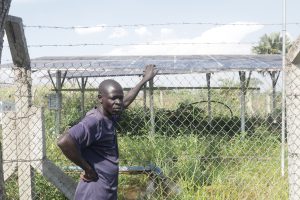
The officials listened to them. Upon inspection, the officials indeed found that the facility could still pump water from underground. They permitted Mathua to use the facility, but on condition that Mathua would guard it for free and also allow the community, including refugees, to use it.
“It was a win-win situation,” says Environment Officer Swaib Andama, who led the inspection team that approved the irrigation facility.
“Now the group is able to grow crops even if it doesn’t rain,” Andama adds. Yumbe is a climate-stressed district which experiences prolonged dry spells and unpredictable rainfall patterns. Most farmers, who mainly rely on rain, in this region struggle to plan for their planting season due to extreme weather conditions.
Experts like Dr. Laban Turyagyenda, the Director of Ngeta Zonal Agricultural Research and Development Institute (ZARDI), attribute these weather changes to large-scale tree-cutting for commercial charcoal production in the region, which has disrupted the rainfall cycle.
“The heat stress from the long dry spells also causes the flowers to abort,” he says. “This makes it hard for the crops to reproduce well”.
But Mathua’s group, now called Amazora Farmers’ Group, is less worried about the unpredictable rainfall patterns. At the moment, the group farms 10 acres year-round, and they also run five fish ponds, thanks to their irrigation system.
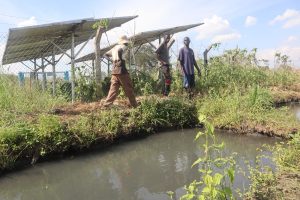
“We sell our produce in Yumbe and as far as Arua City,” says Mathua, who heads Amazora group, which now has 36 members, half of them refugees.
“The profits are shared among us,” he says.” But we also put some money aside to service our solar pumps in case of a mechanical problem”.
Amazora group also gives low-interest loans to its members in case they have emergencies”. Hakim Loro, one of the group members, is one of the beneficiaries. When he fractured his leg in a motorcycle accident last year, the group lent him money and also gave him food stock to support his family.
“I was told to pay when I get back on my feet,” Loro says. “My wife and my older kids are repaying some of it by providing labour for the group, but we are not under any pressure”.
__________________________
Act II: A group of like-minded farmers
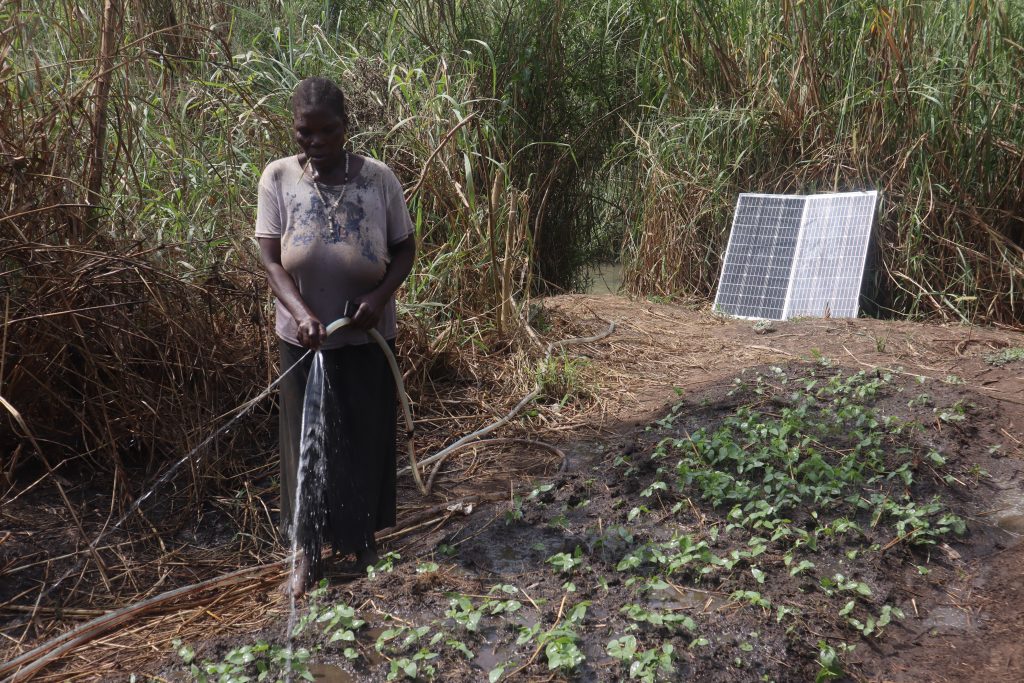
Just some five kilometres away from Bidi bidi refugee settlement, Alma Tiko, 63, is already up at dawn by the banks of River Kochi. She is watering her okra garden with a hose pipe in one hand and a stick toothbrush in her mouth. She is also being supported by some of her group members. The group normally waters their garden three times a day: morning, afternoon and evening.
But Tiko’s group has come a long way. When authorities announced food rations due to aid cuts early last year, the crisis sparked worry in Bidi bidi refugee settlement. At that time, refugees who had been cut off from receiving food relief began combing the neighbouring communities seeking work to feed their families.
As a result, charity organisations got concerned, and some decided to help. In one of the meetings organised by Omia, a local agricultural company, to help refugees and the host communities, an extension worker asked how the two parties would want to jointly address the food crisis.
Tiko stood firm: “A solar-powered pump”. As the crowd listened to her intently, Tiko went on to explain that she inherited 15 acres along the riverbank two years ago after her husband’s death. But she farmed part of it, and most remained idle.
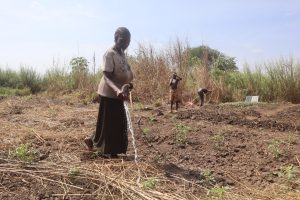
“I have land and water,” Tiko continued. “All we need is the machine that can get the water from river into our gardens,” she says. Tiko also assured the extension worker that, if given the solar pump, she planned to start a farmers’ group that would include refugees, after all, Uganda’s policy allows them to work anywhere.
The officials from Omia were impressed. The following day, they assessed Tiko’s land, which was also approved by the National Environment Authority (NEMA), before the group were handed the solar-powered irrigation pump.
Since last year, Tiko’s group has grown into 27 members, eight of them refugees. They grow mostly vegetables because they sell well in dry seasons. Last October, they bought a second solar irrigation machine at the cost of six million Uganda Shillings to supplement the demand within their group.
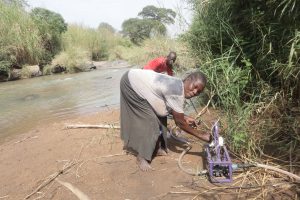
“Now many people want to join us,” says Tiko. “Our goal is to continue being self-sustainable”.
Tiko’s group has also inspired many groups in Yumbe district. But Pasquale Udo, the Refugee Welfare Officer (RWC), says farmers in Yumbe district, who intend to use rivers for irrigation, struggle to get approval from NEMA due to bureaucratic delays. Meanwhile, Hakim Baliraine, the Uganda Chairperson of the East and Southern Africa Small-Scale Farmers Forum (ESSAF), urges NEMA to simplify application procedures for farmers, adding that “they should designate a focal point person in the community to guide farmers on how they can use water bodies” within the confines of the law.
Another challenge is that most rivers in Yumbe are seasonal. River Kochi is the only perennial water body that sustains farmers with gardens close to it. Those without farmlands near perennial rivers struggle since drilling and installing solar equipment that can pump underground water is costlier.
Although Uganda is lauded for its friendly refugee polices, international law experts like Dr Aloysius Tenywa say there is still a need for more inclusive programs. But that too, Dr. Tenywa says, “could tantamount to depleting Uganda’s resources because there is no adequate funding in place”.
Even the World Bank-UgIFT Microscale Irrigation Program, which supported Ugandan farmers to acquire irrigation equipment through a cost-sharing agreement to boost their production, ended just last December.
“Discussions are ongoing,” says Consolator Acayo, the Assistant Commissioner for Information and Communication at the Ministry of Agriculture, Animal Industry and Fisheries (MAAIF). “Right now we are looking for funding”.
__________________________
Act III: Malesh’s quest for hope
Back to Malesh. After weeks with no rain, Malesh was on the verge of giving up. He had tried everything possible to save his dying crops, including pulling his five children from school to till more land. Nothing worked.
Then one day, he heard rumours about the two farming groups, Amazora and Tiko’s group, that were using solar pumps to water their garden. He got curious.
“I didn’t know where they were at first,” Malesh recalls. “But I wanted to see for myself if these groups were really working”.
On a recent day, Malesh trekked to the banks of River Kochi to meet Tiko’s group, perhaps because it was the closest to his home in Bidi bidi refugee settlement. He found locals in that community who directed him to Tiko’s garden.
Upon arrival, Malesh expressed his desire to join the group. Tiko explained to him that there were group rules to follow for every member, including working collectively and sharing profits from the harvests. The old members were willing to let Malesh join them. But first, he had to work as a “garden helper” as they assessed him. He would also harvest some food for his family in the meantime. Malesh agreed.
That evening Malesh went back home, positively beaming. And if he felt he needed to explore other farming groups, Malesh thought, it would be Amazora Farmer’s group. But for now, his only hope was that things would work out for him this time.
“This is where my hope is,” he says. “All I want is a better life for my family”.
This story was produced with grant support from the African Centre for Media Excellence, in partnership with the Mott Foundation.