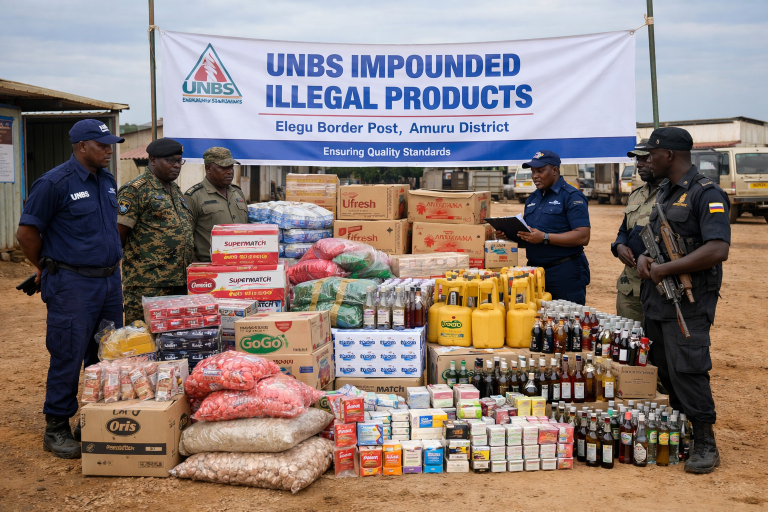
As Uganda pushes for economic transformation, failure to address standards could have far-reaching consequences, such as loss of export markets, reduced investor confidence, public health risks and weak industrial growth
By Willy Chowoo
Kampala, Uganda — Uganda’s ambition to grow its economy tenfold could falter if the country fails to fix a largely invisible but critical system: standards and metrology, the science of measurement that underpins trade, safety, and competitiveness.
This warning dominated the inaugural Standards and Metrology Journalism Awards 2026, where the Uganda National Bureau of Standards (UNBS), in partnership with TradeMark Africa and supported by UK International Development, recognised eight journalists for reporting on quality, consumer protection, and fair trade.

The awards followed a nationwide media initiative that trained 150 journalists and attracted 64 investigative and explanatory stories, signalling a growing recognition that standards are central to Uganda’s economic transformation.
The Invisible Engine of Growth
Speaking at the ceremony, Engineer James Kasigwa, Executive Director of UNBS, issued a stark warning: “If you are not producing quality, then you are not competing.”
He emphasised that the difference between developed and developing economies lies in how seriously they adhere to standards, quality, and measurement systems.
From a litre of fuel to a kilogram of sugar, accurate measurement ensures fairness in trade and protects consumers. Yet, these systems remain largely unnoticed.
“Standards and metrology are invisible, but they are the backbone of global trade and economic growth,” Kasigwa said.
Voice-1: Eng Kasigwa explains more about the need for standards and metrology.
A Crisis of Substandard Goods
Uganda’s market continues to grapple with widespread substandard products, undermining both consumer safety and industrial growth.
Kasigwa revealed that over 50 percent of goods on the market are substandard, and up to 65 percent of alcohol is illicit
These challenges are not abstract. They affect everyday life, from underweight food products to unsafe consumables.
The ED said it is Metrology that will save Uganda from the oil curse
Voice-2: Eng Kasigwa highlights the importance of metrology in the oil and gas sector.
Anna Nambooze, the country director for Trade Mark Africa, illustrated this reality: “You think you are buying one kilogram of bread, but it’s less. You end up consuming more without knowing.”
She noted that while enforcement actions by UNBS often make headlines, the real issue lies in systemic gaps in awareness, compliance, and accountability.
The Cost to Trade and Competitiveness
Uganda’s struggle with standards is also costing it access to regional and global markets.
According to Nambooze, certification is critical for unlocking export potential:
“Certification is the key to unlocking Uganda’s export performance.”
Despite opportunities under the African Continental Free Trade Area, Ugandan products often fail to compete due to quality concerns.
“It is a shared responsibility, from producers to consumers,” Nambooze said.
Consumers, she noted, often tolerate substandard goods instead of reporting them, allowing the problem to persist.
Voice-3: Anna says it is everybody’s responsibility to enforce standards
As Uganda pushes for economic transformation, failure to address standards could have far-reaching consequences, such as loss of export markets, reduced investor confidence, public health risks and weak industrial growth
At the same time, strengthening standards offers significant opportunities for increased exports, competitive local industries, higher incomes, and consumer protection
Kasigwa warned that in today’s globalised economy, Uganda is competing with international producers, not just local businesses.
“If you produce poor quality, even you yourself will not buy your product,” he said, pointing to the growing reliance on imports despite abundant local resources.
Voice-4: Eng. Kasigwa says the strength of the country is quality.
Under Uganda’s development agenda, including Vision 2040 and the Fourth National Development Plan, standards are central to the following:
Kasigwa emphasised that no product can access markets—locally or internationally—without certification.
“You cannot call anything a product before it is certified,” he said.
UNBS is now shifting from enforcement to supporting enterprises, particularly SMEs, to meet standards and grow.
He said UNBS is in a transformative mode to improve the quality of enterprises in the country.
Voice 5—Eng. Kasigwa on the new plan to support SMEs over the next five years
Media as ‘Quality Ambassadors’
A key highlight of the awards was the recognition of journalists as critical players in Uganda’s quality ecosystem.
Kasigwa described them as “quality ambassadors who translate technical science into actionable knowledge for every Ugandan.”
The initiative has already led to the creation of “Standards Desks” at 12 media houses to strengthen coverage of quality infrastructure and consumer protection issues.
Nambooze urged journalists to go beyond reporting crackdowns and instead, explain standards in simple language, highlight both successes and gaps and empower consumers to demand quality
Voice-^: Anna sheds light on media partnerships.
The Bottom Line
The message from policymakers, trade experts, and regulators is clear:
Uganda’s economic future will not be determined by how much it produces but by the quality of what it produces.
“Standards are at the core of every sector,” Kasigwa concluded.
For Uganda, the choice is clear and pressing: embrace quality or face economic collapse.