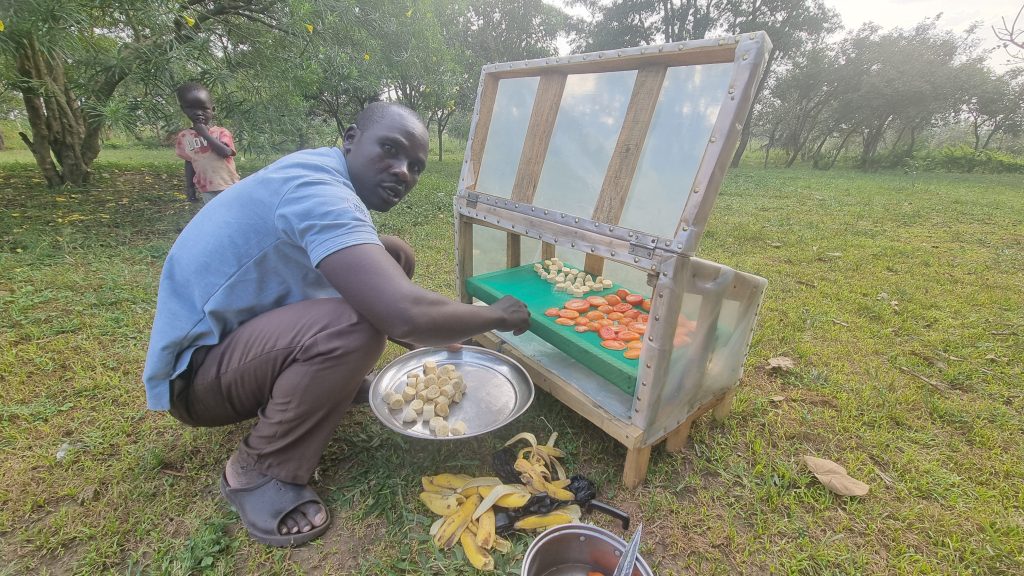
Years ago, Odong would throw away excess food harvests after spoiling. Now he is able to prevent the extra harvests from spoiling by using his homemade solar dryer.
By John Okot
On a recent morning, Richard Odong, 35, peddled his old black bicycle through his village, delivering dried fruits to school canteens and markets.
For the past year, this has been his morning routine. Whenever Odong’s harvests yield plenty, and some of it remains after sales, he dries the extras in his homemade solar dryers to sell again.
“I save a lot of food,” says Odong, boastfully. Odong owns a 15 acre-garden, Olwal Mucaja in Amuru district and grows sweet bananas, pineapples, okra, eggplants, tomatoes and leafy vegetables for selling.
“I can dry the food stock instead of losing it when it spoils.”
Yet years ago, Odong’s story was different. He would throw away excess food harvests after spoiling. In 2024, he was invited to an agricultural trade show in Jinja City, where he saw modern food dryers that could preserve fruits and vegetables longer.
At the show, as one of the agricultural traders explained how the solar dryers worked, Odong marvelled at the technology.
Unfortunately, “I couldn’t afford to buy one,” Odong says. But the former carpenter turned full-time farmer studied local dryers at the show meticulously.
“I examined the machines very well—how they were made and the materials they were made of,” says the father of three.
“Deep down, with my knowledge in woodwork, I knew I could make one when I got back home.”
When Odong returned home in Olwal Mucaja, he researched more about solar dryers. He read books, watched online videos and talked to agriculturalists. He also began gathering building materials such as wood, nails, plastic wrapper and food-grade mesh.
“I made sure that I chose a durable and heat-resistant plastic wrapper that would not contaminate the food,” he says.
The cost barrier
Agriculture employs 70 percent of Ugandans, according to the U.N. Food and Agriculture Organisation (FAO). Smallholder farmers like Odong, who make up 85 percent of farmers, support four million households. But many often live in poverty and struggle to afford modern agricultural equipment that can boost their production. In Uganda, for instance, a solar dryer can cost between three to 25 million Uganda shillings (800 USD- 6,700 USD) depending on the size.
Agricultural experts are advocating for more programs that can provide subsidised modern agricultural machinery. The World Bank-funded Uganda Intergovernmental Fiscal Transfer (UgIFT) program just ended in December last year after supporting 2,839 farmers in 95 districts (out of 146 districts) with solar irrigation machines through a cost-sharing arrangement.
“The government can make favourable arrangements that can allow famers pay in installments after every harvesting season as they use the dryers,” says Hakim Balirane, Uganda Chairperson of the Eastern and Southern Africa Small Scale Farmers Association (ESAFF).
But as the government mulls over viable solutions to support farmers, Consolator Acayo, the Assistant Commissioner for Communication and Information at the Ministry of Agriculture, Animal Industry, and Fisheries (MAAIF), says “discussions are ongoing,” but at the moment, she adds, “the government lacks funding.”
How Odong’s dryer works
But Odong is already benefiting from his innovation. He has seven homemade solar dryers that measure four metres in length and three meters in width. Inside the rectangular chamber is a greenish food-grade tray which has mesh holes that let moisture from the food drip through.
On the outside, the homemade dryer is also covered by a transparent plastic sheet that is able to protect the drying food from being contaminated by dust, insects, and birds as well as trapping heat from sunlight (solar radiation) into the enclosed space easily. The drying chamber is made of a dark colour to ensure easy heat absorption and retention, unlike modern dryers that use solar panels that can circulate warm air inside the chamber until the food dries.
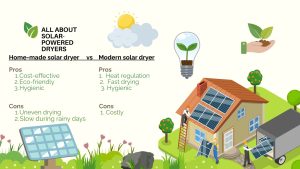
Odong’s solar dryer takes two days to dry fruits. But the downside is that drying could take longer during rainy seasons, despite the dryer being cost-effective.
“This limits production, especially when there is high demand,” Odong says.
Expert warning
There is another potential risk. Dr Stella Kabiri of Sasakawa Africa Association warns that homemade dryers lack temperature control mechanisms, and this can lead to uneven drying of food, especially in fickle weather conditions.
“If the food is not dried well, the wet parts can become fertile grounds for microbial load or germs,” she says. “This may lead to contamination of the food.”
Another danger is that some local dryers could be made of bad plastics. When heated, Dr. Kabiri cautions, some plastics may leak toxins like dioxins into the drying food, putting the health of the food consumers at risk.
Polypropylene (5 PP) and High-Density Polyethene (2 HDP) may be safer plastic options because they are heat-resistant and stable. But even so, Dr. Kabiri says, no plastic is entirely inert as they can release chemicals overtime.
“Glass would be ideal,” adds Dr. Kabiri.
Nutritionist Enid Achiro also says that unregulated heat levels may kill certain micronutrients, especially vitamin C, which is “sensitive” and “unstable.”
“Bright fruits with vitamin C can be dried well between 50 and 60 degrees Celsius based on the bulk,” she says, adding that “as long as the heat level is controlled well, this can only be done well by a modern solar dryer,” she adds.
But Odong strives to prepare his snacks with care. He also hopes to buy a modern solar dryer one day as soon as he saves enough. On a recent warm afternoon, he sliced bananas for the dryers while his children ran around, enjoying some of his dried banana snacks.
“This is now my job,” he says. “ I plan to buy enough dryers to meet the demand”.