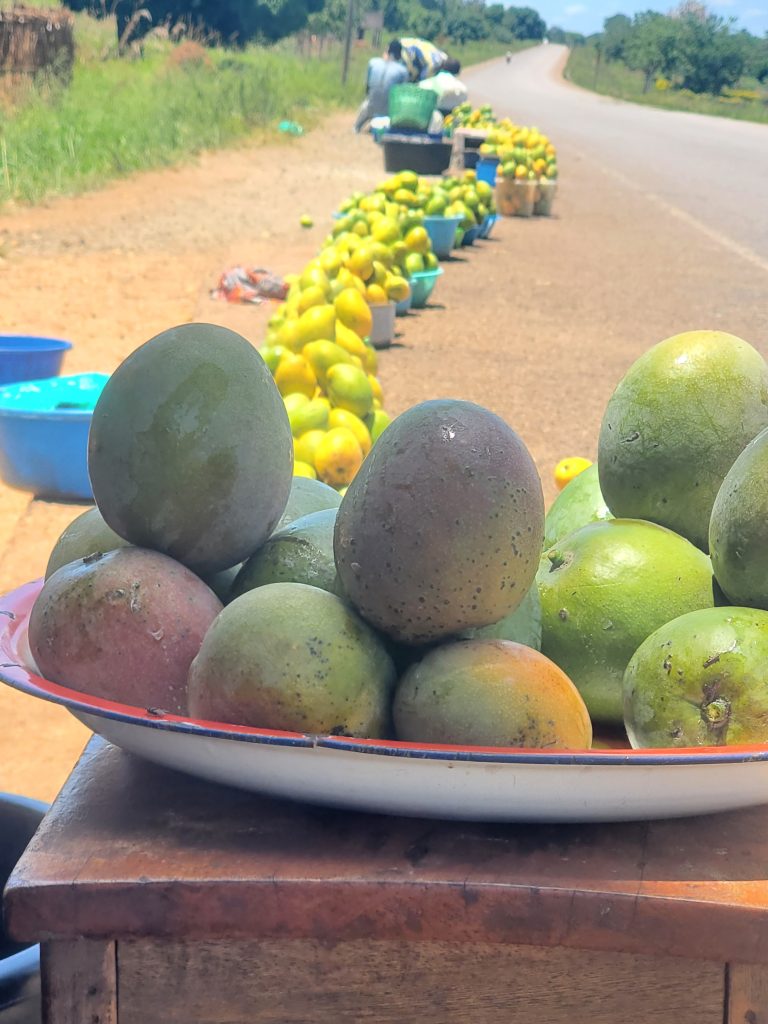
For generations, Atiak has been known across northern Uganda as the home of early mangoes.
By Chowoo Willy
The roadside markets of Atiak are unusually quiet.
Under the scorching midday sun, a few women sit beside empty baskets that, in years past, would have been overflowing with bright yellow mangoes. The air, once filled with the sweet scent of ripe fruit and the chatter of traders negotiating prices, now carries a different mood—uncertainty.
“I used to sell at least three basins a day,” says 38-year-old Janet Ayaa, a mango vendor and mother of four. “Now, you can sit here the whole day and not even sell one.”
This is the new ordeal for the mango business in Atiak: climate change is taking center stage. Prolonged rain or drought has drastically altered the mango season in the area.
For generations, Atiak has been known across northern Uganda as the home of early mangoes. While other regions waited weeks for their harvest, Atiak’s mangoes ripened first, giving farmers and traders a valuable head start in the market.
But that advantage is disappearing.
This season is the worst; by mid-April, the mangoes are still raw, as traders who usually come as far as Kampala to buy in wholesale have ended up in disappointment. The mango season always begins as early as mid-March
“We used to buy a full truck every week, but when we came here, the place is green instead of yellow; it was a huge setback to our business,” said Anges Namazzi, mango wholesaler.
A Season That Once Kept Time
In the past, the rhythm of life in Atiak followed a predictable pattern. Rains would begin around March, nourishing mango trees just in time for them to produce the fruits. By late March or early April, the fruits would ripen earlier than anywhere else in the region. By April 20th, the mangoes for the first season would be close to over
“It was like a calendar,” Okot Justo Gwanga recalls an elder from Ker Kwaro Atiak. “We didn’t need forecasts. The trees told us when the season had come.”
The early mango harvest was more than just agriculture; it was an economic lifeline.
Women, who dominate the local mango trade, would buy directly from farmers (at homesteads) and sell along highways and in nearby towns. Some would collect it from their gardens. The income paid school fees, bought food, and sustained households.
But today, that natural calendar is broken.
For Atenyo Rose (67), a resident of Pupwonya North Village and a mango trader for nearly a decade, the business has become her primary source of livelihood. However, recent changes have not only disrupted her income but also affected both the quantity and quality of her harvest.
“It didn’t produce many fruits, and even the few that came are small. This is something I have never experienced before, and I don’t know what to do,” Atenyo says.
When the Rains No Longer Come
Farmers and traders point to a common culprit: changing weather patterns.
“The rains delay, or sometimes they come too heavily and then stop suddenly,” says Okullu Solomon, a local farmer in Atiak. “The trees don’t flower properly anymore.”
Okullu, a resident of Pabuga South Cell—one of the areas known for its thriving mango trade—says farmers have been experiencing these changes over the past three years.
“The mangoes now ripen in sequence—branch by branch—something that never used to happen before. As farmers, this has greatly affected us,” he explains.
According to the information from the Meteorological Department, the rainfall pattern in Atiak has shifted over the years. Atiak used to get rain at the beginning of March, but it has now shifted to the end of March or come earlier than that, affecting not only mango but also human activities.
Omony George Williams, manager of weather forecasting at the Uganda National Meteorology Department (UNMA), says the pattern change is a result of climate variation.
“Nowadays, the general pattern has changed; sometimes, they come earlier, sometimes a little, sometimes the whole season even fails, so that variability has affected a lot of human activities,” he adds.
Atiak is one of the sub-counties in the Acholi sub-region, which has lost forest cover due to massive deforestation as a result of the charcoal business, logging, and timber.
According to agricultural experts in Amuru District, mango production is highly sensitive to climate conditions, particularly rainfall and temperature during flowering.
“When rains delay or drought persists, it disrupts the flowering cycle of mango trees,” explains Bongomin Alfred, agriculture officer. Adding that, “This leads to fewer fruits, delayed harvests, and sometimes complete crop failure.”
The result is a shorter, unpredictable harvesting season—and significantly reduced yields.
The Women Bearing the Burden
For women like Janet Ayaa, the impact is immediate and personal.
With fewer mangoes available, prices have risen at the farm level, making it harder for traders to buy in bulk. At the same time, inconsistent supply drives customers away.
“People come expecting mangoes, and when they don’t find them, they go,” she says. “Even when you finally get some, the season is too short to recover your losses.”
For a small basket, it now costs sh10,000, something that used to be sh1,000 at the peak of the mango season in Atiak.
Another vendor, 45-year-old Rose Lamunu, says the unpredictability has made planning impossible.
“Before, we knew when to prepare. Now you can invest your little money and lose it because the mangoes delay or don’t come at all.”
For many women, mango trading was one of the few accessible sources of income. Its decline is pushing households deeper into financial vulnerability.
“This is little; what we get is spent at the source. We use it to buy food; we are not able to pay school fees,” Akumu Grace notes. She sells mangoes along the roadside.
A Changing Climate, A Changing Crop
Climate experts warn that what is happening in Atiak is part of a broader trend.
Rising global temperatures and shifting rainfall patterns are altering crop phenology, the timing of flowering and fruiting.
“Mango trees require specific conditions to flower and fruit properly,” Omony says, a climate change specialist familiar with northern Uganda. “When those conditions are disrupted, the entire production cycle is affected.”
According to Omony, mango production is highly sensitive to climate conditions, particularly rainfall and temperature during flowering.
“Variation of rainfall seriously affects flowering of mango trees; for a mango tree to flower very well, it needs a period when there is water stress,” he adds.
In Atiak and Lacekocot in Pader district, the water stress month is December, and sometimes it extends to January. This is when mango trees start flowering, and by February, the fruits shall be ready and near ripening
However, this year, the rain came around January and affected the flowering of most mango trees, which drastically led to poor quality and a reduction in the quantity of mangoes across the greater Atiak Sub-County.
Omony notes that the early return of the rain affected the flowering due to water vapour, which was available in the atmosphere, and this affected the development of the flowers of the mango trees.
“The water will wash away some of the flowers, and pollination will not take place, so in the process, you will see some small flowers; they may not bear fruit, and then all of them will fall off. For mango trees to flower well, there must be a total dry spell, ” he notes.
Away from the mango tree, not flowering, some are affected by induced climate change diseases that retard the growth of the mangoes. Omony reiterates that sometimes the fruits turn into a different colour, affecting the growth of the fruits
“When rain comes when mango tree is flowering, it will result in the development of some disease and will continue eating the flowers; the flowers may come small during that period,” he notes.
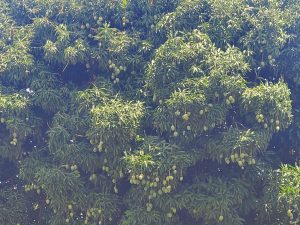
The locals report many cases of mangoes rotting, especially those that are yet to ripen. Most of them are not aware of what could have caused the variations.
“The ones that are ripening late are rotten; it is just a total waste to use, and we don’t know what to do now,” Akumu adds.
This year, most parts of Uganda suffered from off-season rain, which came earlier than expected. It altered the normal flowering and development of mango fruits during the dry season and affected early mangoes from Atiak.
Northern Uganda, which heavily relies on conventional rainfall, has two rainy and dry seasons. The first rain season used to begin from March to early June, while the second rain season begins from July to late November, and the rest of the months are for the dry spells.
In a sub-county like Atiak, where livelihoods depend heavily on seasonal crops, even small climate changes can have outsized economic consequences. Crops such as maize and beans, which were planted early, are now drying up as well.
“We are not sure of anything. Our crops are drying as well, and I’m not sure when rain will come again, maybe May,” said Openytoo Lawrence, a local farmer in Kibogi Village.
From Abundance to Uncertainty
In the past, trucks would line up in Atiak to transport mangoes to markets as far as Gulu and beyond. Today, such scenes are increasingly rare.
“There used to be so many mangoes that some would even go to waste,” the elder. Okot Fred recalls. “Now, people are struggling to find enough.”
The transformation is not just economic—it is cultural.
Mango season once marked a time of abundance, community activity, and social interaction. Its decline represents the loss of a shared experience that defined the identity of Atiak.
Many of the residents here who depended on the early mango seasons may wait to see if next season will be the same story.
Bongomin, the agricultural office in charge of greater Atiak, explains that this is the second season that the area has been experiencing drastic change.
“Last year, the rainy season left early, and from November, we didn’t have much rain. This year, it returned early in February, which was not normal, disrupted the rainfall pattern, and affected crop growth,” Bongomin notes.
Are Farmers Adapting?
Efforts to adapt are underway, but progress is slow.
Some farmers are experimenting with drought-resistant crop varieties or diversifying into other crops. Others are considering irrigation, though the cost remains prohibitive for many smallholders.
“We are encouraging farmers to adopt climate-smart agriculture practices,” says Bongomin, the agriculture officer. “But resources are limited, and awareness is still low.”
Without significant support, many farmers risk being left behind.
Mango farmers in the district are not operating on a commercial scale; most are smallholders. However, some have begun adopting irrigation systems under the government’s Micro-Scale Irrigation Programme.
The program mainly supports the growing of vegetables and high-value crops such as coffee and bananas and is better suited to farmers engaged in commercial production—something most smallholders in the district are still unable to afford.
The Silence of the Market
Back at the roadside market, Janet Ayaa watches as a motorcycle passes without stopping.
She adjusts her empty basin and sighs.
“This business helped me raise my children,” she says quietly. “Now I don’t know what will happen.”
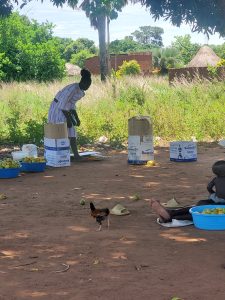
The mangoes that once defined Atiak’s economy and sustained its women are no longer reliable.
And as the climate continues to change, the future of this once-thriving seasonal trade hangs in the balance.
Due to the current shortage of mangoes, prices have surged. A small basket now sells for about sh10,000, compared to the previous sh3,000 to sh5,000 when supply was abundant.
The sub-county authority says this has greatly affected them in terms
of revenue. Akera Samuel, the sub-county chairman of Local Council Three, believes this is the worst season for mangoes in the sub-county.
“We used to get Sh4 million as revenue monthly in the sub-county, but we have only got Sh500,000 from the tenders,” Akera maintains.
The early mango season had broadened the market for the mangoes from the areas, with traders coming from Central Uganda, outside the region. Some export them to South Sudan and Kenya.
Amuru district local government has also raised concerns over the dwindling mango business in the sub-county. The District Senior Commercial Officer, Kidega Samuel, expressed scepticism that the money will be collected as local revenue
“We have fear that will definitely affect our revenue,” he notes.