For many of the smallholder farmers in the region accustomed to the hand hoe, the machine represents more than technology. It represents time saved, labour reduced and, potentially, more land brought under cultivation.
By Johnisani Ocakacon
NWOYA
The engine suddenly coughs to life, breaking the quiet of the early morning stillness with the horsepower of forward traction.
An instructor rushes to guide the woman behind the walk-behind engine the proper way of gripping the handlebars. “Gently lift the machine up and push it forward. You are now ready to move. Hold it firm to the ground. Plow” His voice rings louder than the sound of the engine.
Her energy is strong enough to match the weight of the engine. Before her, the red soil turns over in neat lines as the small tractor moves steadily across the field eastward. There is no driver’s cabin. No massive wheels. No giant roaring engine of the kind normally associated with agricultural mechanisation in Nwoya district.
Instead, it is the farmer walking behind her small horsepower tractor in Anaka Town Council. This is the walk-behind tractor, a small two-wheel machine that is quietly changing how some smallholder farmers in Northern Uganda access mechanisation.
For many of the smallholder farmers in the region accustomed to the hand hoe, the machine represents more than technology. It represents time saved, labour reduced and, potentially, more land brought under cultivation.
In Nwoya district, where many smallholder farmers cultivate only a few acres of land each season, the technology is being promoted as a more appropriate alternative to large tractors.
Charles Kaaya, the director of Shalom Ventures Uganda Limited, a leading supplier of high-quality agricultural tools, tractor spare parts, and engineering equipment in Uganda says, “the larger tractors are often considered too uneconomical for farmers with difficult terrain, small and fragmented plots, making smaller machines a better fit for their circumstances.”
In addition to making the tractor accessing to many small holder farmers in Uganda, Shalom Ventures Uganda Limited operates a tractor spare outlet in Nwoya district from where it trains small holder farmers how to operate or maintain the walk behind tractors.
“If a smallholder farmer has only one acre and calls for a 75-horsepower tractor, the tractor may finish the work in less than 30 minutes. For the tractor owner, it is not a viable business to travel to the farm for such a small job. As a result, farmers with smaller plots were missing out on mechanization services,” Kaaya said.
According to Kaaya, Shalom Ventures Uganda Limited partnered with the Climate Smart Jobs project to explore more ways of making mechanization accessible to the smallholder farmers, including promoting the walk-behind tractors in the entire Northern Uganda region.
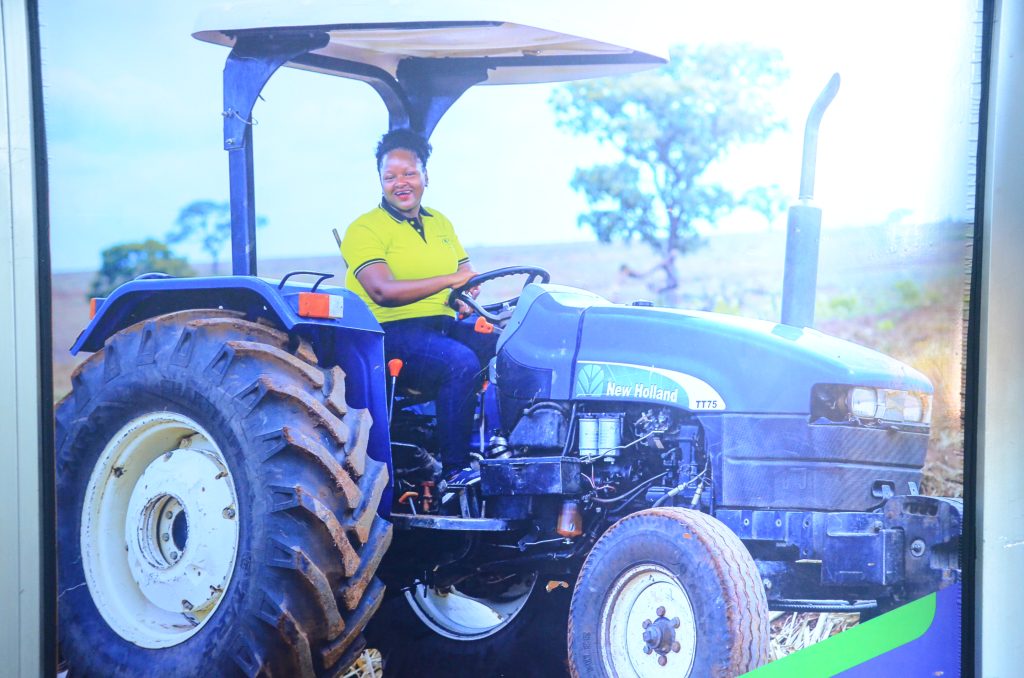
“One of the solutions was to introduce the walk-behind tractors of less than 50 horsepower. They consume less fuel, cause less pollution, cheaper and are easy to operate, and can cultivate about two to three acres a day,” he said.
Kaaya explained that “the machine is smaller, relatively easier to manoeuvre and can be fitted with different implements depending on the model and attachments. It can be used for land preparation, planting, transportation, irrigation and other farm operations.”
Inclusion of Women
Despite being bread winners for many families, women have often been left behind in Uganda’s agriculture mechanization agenda.
According to a baseline study conducted by Shalom Ventures Uganda Limited, a smallholder farmer in Lango, Acholi and the West Nile, cultivate only a few acres using hand hoes and family labour.
With limited access to electricity, they operate on uneven terrain and lack the capital to purchase a large tractor. These factors, the report says, compromise the farmers’ quality of life and complicate the process of escaping the household poverty trap.
In an environment of Climate Change, a technology that ignores these realities may therefore be technically impressive but practically useless to the common farmer, the report adds.
Appropriate mechanization takes a different approach. Equipment is designed or adapted to be smaller, affordable, easy to operate, repairable locally and suitable for small plots. This can allow farmers to mechanize individual stages of production rather than having to mechanize an entire farming operation at once.
The design makes it user friendly for women and the young people, according to Jona Mbabazi, the Managing director of Shalom Ventures Uganda Limited.
“We have also trained women as tractor operators to make the mechanization work easier and simpler, allowing farmers to cultivate much more land than they could when using hand hoes.” Mbabazi said.
More than 50 women have been trained to operate the small tractors, with some going on to acquire their own machines.
“This is a very good opportunity for women in this region because it gives us the means of earning income and owning productive assets,” a woman undergoing training in tractor operation with Shalom Ventures Uganda Limited stated.
She added that mechanization was improving women’s financial status and increasing agricultural production among rural households.
According to Mbabazi “Women are increasing the acreage of their farms while some have used the money, they earned to acquire more land for cultivation”.
Since smallholder agriculture often depends heavily on human labour, the tasks such as land preparation, planting, weeding, harvesting, threshing and processing can consume enormous amounts of time and energy.
Across Northern Uganda, women and young people frequently carry a substantial share of this workload. When appropriate machines take over the most physically demanding tasks, farmers can redirect their time towards activities that generate income, improve household welfare or expand their enterprises.
Mechanization can therefore become more than a productivity tool. It can also be a tool for inclusion and empowerment.
“We were particularly interested in female tractor operators and recruited more than 75 percent women among the operators we trained. We want to promote women’s participation in mechanization,” Kaaya said.
Climate Benefits
The small horsepower tractors are known to provide several climate benefits in terms of soil compaction as they are light and not able to create hard pans, thereby building environment conservation and sustainable livelihoods.
Jacob Olweny, who works with Palladium under the Climate Smart Jobs project in the Acholi sub region says, “the introduction of the tractors was part of efforts to help farmers shift from traditional farming methods to modern and environmentally sustainable practices.”
Olweny explains that “the goal is to empower smallholder farmers to change their mindset from traditional farming to using modern farm machinery through the promotion of equipment such as seed drills and zero-till planters to support climate-smart agriculture and environmental conservation.”
Several farmers have adopted the use of the small horsepower engine in their farms. Francis Okello, a smallholder farmer from Paidwe Village in Purongo Sub-county, Nwoya District, owns a walk-behind tractor. He said mechanization had transformed his farming activities.
“I now own 10 acres where I grow maize, groundnuts, cassava, millet, rice and beans, both for household consumption and commercial purposes,” Okello said.
He said the tractor had multiple uses, including plowing, weeding, harvesting, generating power, transportation and shelling his grains after harvest.
“When I use it well, I can earn nearly sh10M from the tractor in one season. It has helped me adapt to the effects of climate change because one machine can perform many different tasks.” he said.
Okello said farmers previously struggled to hire large tractors, leading to delays in preparing land and planting crops which reduced their productivity as well.
“Before I acquired the walk-behind tractor, hiring a big tractor was a major challenge. Farmers would often plant late because they had to wait for tractors to become available. Now I can prepare my gardens early and plant on time,” he said.
Okello hires his tractor to other smallholder farmers in his area, which has enabled him to acquire more land and expand into commercial farming.
“Using a hand hoe, I could only cultivate about one acre. Now, in one season, I can open three to four acres of my own.” he said.
Okello said the machine was affordable compared with larger tractors, and its spare parts were readily available in Shalom Ventures Uganda Limited stores in Nwoya district.
Expanding access
David Okello, a tractor operator in Purongo Sub-county, said he had trained more than 100 farmers in the use of walk-behind tractors.
“Learning to operate a walk-behind tractor can take only two days. After that, a person can start using it to plough gardens. Many people are now moving away from traditional farming and turning to commercial agriculture,” he said.
He said the machines could cultivate three to four acres a day, depending on the operator and working conditions of the tractor and the land terrain.
David also practices farming, growing maize, groundnuts, rice, cassava, beans and soybeans, which he said had improved his financial situation.
Bosco Oyat, a farmer from Got-Ngur Village in Purongo Sub-county, said he belongs to a group that shares a walk-behind tractor.
“In our group, people are benefiting because we used to cultivate only one acre, but with this tractor, members can cultivate more than four acres. Productivity in our area has increased because members have embraced mechanization,” Oyat said.
Another farmer, Jacob Odora from Purongo Sub-county, called for more walk-behind tractors to enable communities to make better use of their land.
“The land in Acholi is very fertile, but much of it remains idle because farmers cannot open large areas using hand hoes. More walk-behind tractors would help communities improve their livelihoods,” Odora said.
He added that mechanization could also help reduce pressure to sell land.
“The walk-behind tractor has helped address some of the challenges surrounding land because people can now cultivate their land and benefit from it instead of selling it for quick money,” he said.
For the smallholder farmers of Acholi, the growing use of walk-behind tractors is not simply about replacing the hand hoe. It is opening opportunities to cultivate more land, increase production, improve household incomes and make agriculture a more viable commercial activity while supporting communities to adapt to a changing climate.
According to data from the Ministry of Agriculture, Animal Industry and Fisheries (MAAIF), tractor ownership among farmers in Uganda’s Acholi Sub-region remains relatively limited, although Acholi has one of the highest proportions of farmers using tractors nationally.
MAAIF monitoring data indicates that 18.65 percent of farmers in Acholi use tractors. In December 2023, the ministry also launched a mechanization programme involving the distribution and promotion of walk-behind tractors, with a major focus on Acholi, Lango and West Nile.
Making mechanization accessible
Beyond Plowing
Dickens Ebonga, a mechanic with Wash and Will Walk-Behind Tractors incharge of Northern Uganda, said their work includes repairing and maintaining the machines and training farmers in their use.
These tractors have multiple functions. They can be used for ploughing, harvesting, shelling and transportation. They can also support irrigation during the dry season and generate power,” Ebonga said.
He said farmers were also supported to identify the right spare parts and carry out repairs when their tractors developed mechanical problems.
“We help farmers repair their tractors and acquire the right spare parts so that they can continue using the machines to improve their farming, move from subsistence to commercial agriculture and increase household incomes,” he said.
Ebonga said some walk-behind tractors had been supplied to farmers through MAAIF, while individuals had also acquired machines for their own farms.
“The walk-behind tractor is affordable, easy to operate and farmers are buying them for personal use because they have seen the benefits. The machines have enabled farmers to increase their acreage and production,” he said.
Ends.