As Uganda expands its rhino population beyond Ziwa, genetic testing, selective breeding and new imports are key to preventing inbreeding and maintaining genetic diversity.
By Willy Chowoo
Gulu City.
For nearly three decades, Uganda’s rhino conservation programme has focused on rebuilding a population wiped out by poaching, insecurity and habitat destruction.
Now, as the country’s southern white rhino population reaches 61, conservationists are paying their attention to a less visible but potentially critical question: Are Uganda’s recovering rhinos genetically diverse enough to sustain a healthy population for generations?
The question has become increasingly important as Uganda moves rhinos from its established breeding population to new conservation areas, including Ajai Wildlife Reserve and Kidepo Valley National Park.
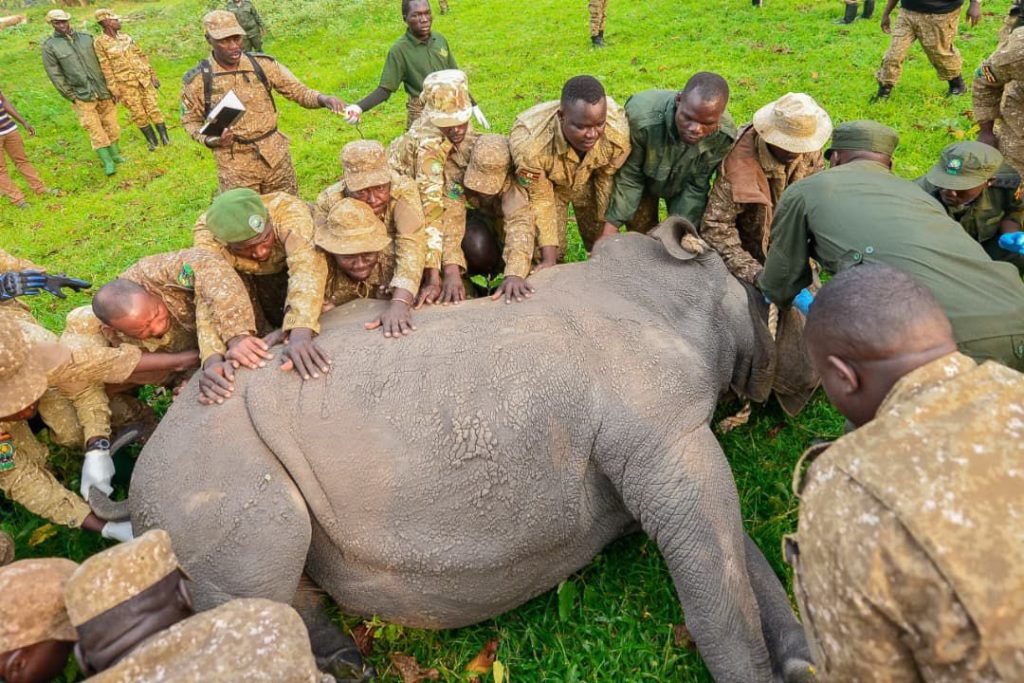
In January 2026, Uganda Wildlife Authority (UWA) moved four southern white rhinos from Ziwa to Ajai Wildlife Reserve—the first phase of a programme targeting an initial breeding population of 20 rhinos there.
Two months later, UWA transferred rhinos to Kidepo Valley National Park, 43 years after the last rhino in the landscape was killed. The initial Kidepo programme targets eight animals.
Uganda started its modern breeding programme with only six founder rhinos—three males and three females.
Uganda’s National Rhino Conservation and Management Strategy plan 2018–2028 provides for supplementing the country’s original founder population and establishing additional viable populations, a strategy for genetic diversity .
Dr. Patrick Atimnedi, Assistant Commissioner for Veterinary Services at UWA and National Rhino Coordinator, explains that the genetic question has been part of Uganda’s conservation strategy from the beginning.
“Those founders must be supplemented by either 14 or 16 individuals to make the founder become 20, as recommended by the African Rhino Specialist Group.” Dr. Atimnedi explains.
For Dr. Atimnedi, the significance is straightforward: Uganda cannot build a long-term rhino population on a foundation of only six animals. “That in itself is meaning that you are not going to establish a population based on a small founder of six individuals. You must add more there.”
This means Uganda’s rhino recovery is not simply a numbers game. It is also an exercise in managing the genetic health of a population rebuilt from a very small foundation.
Dr. Eric Morris Enyel, a former the Laboratory Director for Uganda Wildlife Authority Diagnostic and Research Laboratory now working as a chief wardne at Kidepo Valley Conservation Area (KVCA) , says the authority is now combining detailed pedigree records with genetic analysis to guide breeding and translocation decisions.
“We are trying to improve the genetic pool, we construct that relationship in the population. and do sequencing to make us understand genetic line.” Dr.Enyel notes.
Uganda’s rhino conservation strategy goes beyond increasing population numbers. It provides for biological management aimed at maintaining genetic diversity, reducing inbreeding and preventing a few dominant males from monopolizing breeding over successive generations.
The strategy intends to maximize gene-allele diversity in each rhino populations passed into future generations while minimising loss of genetic diversity and genetic drift.
This is intended to ensure that the country’s recovering rhino population remains genetically healthy and viable in the long term.
The recovery therefore represents not only an increase in numbers, but a broader attempt by Uganda to rebuild a wildlife population that was wiped out by decades of poaching, insecurity and habitat loss.
Now comes rewilding and genetic management:
Rhinos are being moved from Ziwa to Ajai and Kidepo, while UWA is using pedigree records, genetic sampling and animals from outside Uganda to strengthen the population.
The next measure of success may therefore not simply be how many rhinos Uganda has.
But it may be how genetically resilient those rhinos are.
The current reintroduction programme therefore represents an attempt not simply to increase wildlife numbers, but to restore a species that once formed an important part of Uganda’s natural heritage.
A recovery built from a small foundation.
Uganda’s modern rhino recovery programme began in 2001 when two southern white rhinos from Solio Ranch in Kenya were brought to the Uganda Wildlife Education Centre in Entebbe. The pair did not breed successfully.
In 2005, four additional southern white rhinos were brought from Solio Ranch and transferred to Ziwa Rhino Sanctuary. In 2006, two more southern white rhinos were donated by Disney’s Animal Kingdom in Florida, United States.
The six animals became the foundation of Uganda’s modern rhino breeding programme.
According to figures in Uganda’s National Rhino Conservation and Management Strategy, the six founders have produced 41 calves over the subsequent two decades.
The population stood at 53 before Uganda received eight additional southern white rhinos from South Africa in December 2025.
Speaking at the handover John Makombo, Commissioner Biodiversity Management at UWA described the arrival of the eight rhinos as a major boost to Uganda’s conservation efforts.
“This is a significant boost to our national rhino recovery programme. Beyond conservation, this donation strengthens Uganda’s profile as a competitive nature-based tourism destination and a trusted partner in international wildlife conservation,” Makombi said.
He further said that UWA would protect the rhinos and provide a conducive environment for them to breed and multiply.
The latest State of Wildlife Resources report 2026 puts Uganda’s southern white rhino population at 61 animals as of February 15, 2026, with 55 at Ziwa.
This report shows an increase of 44 rhinos between 2014 and 2025, the highest increase over a decade, one of the country’s notable wildlife recovery successes.
The Executive Director of Uganda Wildlife Authority (UWA) Dr. James Musinguzi attributes the recovery successes to increasing restocking provision plans and the use of technology-supported monitoring tools to help monitor animals.
“The advances are indicative of enhanced patrol, species recovery, and restocking provision plans, ranger presence, community cooperation, and increasing use of technology.” Dr. Musinguzi highlights.
But population growth brings a new conservation challenge.
A population descended from a small number of founders can face increased relatedness if breeding is not carefully managed.
This is why Uganda’s strategy places emphasis on supplementing the founder population and managing the genetic relationships among animals.
To prevent inbreeding and maintain genetic diversity, the Uganda Wildlife Authority have undertaken several management strategies including:
Bringing rhinos from outside Uganda.
Uganda’s wild rhino populations were decimated by poaching and insecurity during the 1970s and 1980s, leaving the country without wild rhinos by the early 1980s.
Historical records show that Uganda once supported substantial populations of eastern black rhinos and northern white rhinos.
The loss left conservation authorities with no option but to look beyond Uganda’s borders when rebuilding the population.
This strategy is to help diversify the genetic foundation of the recovering population. Dr. Enyel says this is to help strengthens the genetic base already established in the country.
It became particularly significant in December 2025 when Uganda received eight southern white rhinos from Munyawana Conservancy in KwaZulu-Natal, South Africa.
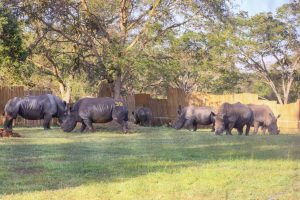
Dr. Atimnedi adds that bringing rhinos outside the country is part of Uganda’s genetic diversification strategy. The balanced composition intended to strengthen breeding and long-term population growth.
The move provides the recovering population with additional genetic material beyond the original six founders.
Uganda is also looking for additional animals.
A team from UWA travelled to Kenya in April 2026 and met the leadership of the Kenya Wildlife Service and Lewa Wildlife Conservancy as part of efforts to source rhinos for genetic reasons.
“Again, we went to source rhinos for genetic reasons. And the process is still going on,” Dr. Atimnedi explains.
Supplementation is being treated as an ongoing part of Uganda’s rhino management strategy rather than a single intervention.
Building the rhino family tree.
At Ziwa Rhino Sanctuary, conservation managers have maintained detailed records of individual rhinos and their relationships.
The animals are individually identified, and managers record which male bred with which female and which calf resulted.
“We know their genetic line,” Enyel says. “When they are breeding, we monitor them.”
The records allow conservationists to construct what Dr. Atimnedi describes as a genealogical tree—identifying fathers, mothers, grandparents and subsequent generations.
The family relationships are mapped through a pedigree system.
“We have what we call the family tree, so we know which mother gave birth to which one,” he notes
The records provide a picture of the relationships between generations.
But the pedigree information also has a limitation.
While conservation managers know the mothers of offspring, Dr. Atimnedi maintains that the identity of the fathers has not always been established with complete certainty.
“Much as we know the mothers of those offsprings, we don’t coincidentally by 100% know the fathers,” he adds.
To address this gap, UWA commissioned a genetic study to establish parentage and examine genetic diversity.
Dr. Atimnedi study has now been completed. “The report by the geneticists has just come out. That is the report we are going to use. It has very clear recommendations.”
The genetic analysis therefore adds another layer of information to the existing pedigree records.
The records allow conservationists to construct what he describes as a genealogical tree—identifying fathers, mothers, grandparents and subsequent generations.
Instead of relying entirely on observed breeding histories, conservation managers can use genetic information to determine relationships and assess the diversity of individual animals.
Selecting rhinos by their genes
The findings of the genetic study are already influencing the selection of rhinos for new populations.
Dr. Atimnedi says, “We want the ones that are genetically diverse and the ones that are not closely related genetically.”
This is particularly important as Uganda moves animals from its established breeding population to new conservation areas.
The selection process is therefore not based simply on which animals are available.
Genetic relationships are becoming an important consideration in deciding which rhinos should form new breeding groups.
UWA’s approach is intended to reduce the risk of moving closely related animals together and creating genetic bottlenecks.
The authority is using two approaches: the genetic information from the newly completed study and the introduction of rhinos from outside Uganda.
“We are using these two approaches to see that we do not move close relatives and those with limited diversity,” he explains.
Managing rhinos as a metapopulation
The national rhino conservation and management strategy emphases on importance of enhancing the national and regional meta-population management to maintain genetic diversity.
Perhaps the most significant element of Uganda’s genetic strategy is the decision to manage the country’s rhinos as a metapopulation.
This is where one or more breeding rhinos are swapped between Uganda populations, or introduced from outside the country, every rhino generation up to 14.5 years.
This means managing different rhino groups as components of one wider national population.
These groups can exist in different locations but remain connected through deliberate management interventions.
The approach means that a rhino population established at one site will not necessarily remain isolated from the others.
If a male becomes dominant in breeding within one population, for example, UWA can move it to another location.
“When you see relationships or when you see a male that has overdominated breeding, you remove it from where it is and take it elsewhere,” Dr. Atimnedi narrates.
This movement is intended to prevent genetic bottlenecks and excessive relatedness.
This does not mean that rhinos in Kidepo will remain Kidepo and at Ajai will remain Ajai. Instead, males and females can be moved among rhino populations as part of long-term genetic management.
Dr. Atimnedi says the approach is guided by recommendations from the African Rhino Specialist Group, a branch of the International Union for Conservation of Nature IUCN.
This means the establishment of rhino populations in new locations is not intended to create completely independent populations.
Rather, the different populations can form part of a wider conservation network in which animals are moved when necessary to maintain genetic health.
Taking the genes to Ajai and Kidepo
Uganda’s rhino recovery has now moved beyond rebuilding numbers at Ziwa to establishing new populations in the wild.
In January 2026, UWA moved four southern white rhinos from Ziwa to Ajai Wildlife Reserve—the first phase of a programme targeting an initial breeding population of 20 rhinos there.
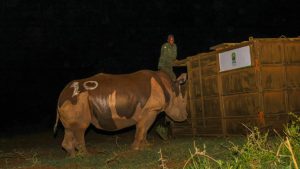
Two months later, UWA also translocated two rhinos to Kidepo Valley National Park, 43 years after the last rhino in the landscape was killed.
These movements therefore represent more than geographical expansion. But it is an important test of Uganda’s metapopulation strategy.
The genetic study commissioned by UWA is being used to select animals for new populations based on genetic diversity and relatedness.
The aim is to establish viable populations without creating new genetic holdups.
In the longer term, the metapopulation approach provides for movement of animals between different locations where necessary.
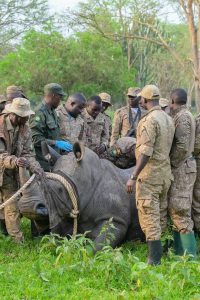
This could allow Uganda to maintain genetic connectivity even as its rhino population becomes geographically dispersed.
Director of Tourism Development at the Ministry of Tourism, Wildlife and Antiquities, Dr Basil Ajer, says the translocation is a strategy aligned with the national strategic framework to strengthen genetic diversity, expand the rhinos’ range and secure the species for future generations.
The idea complements the metapopulation approach because long-term genetic connectivity ultimately depends on maintaining viable populations and the ability to move animals between them.
Rewilding Rhinos is More Than Moving Animals
Uganda’s rhino population may have grown from six founder animals to 61, but returning the species to new landscapes requires far more than transporting animals from one location to another.
Behind every translocation is a complex conservation operation involving habitat assessment, security, veterinary care, infrastructure, community engagement, monitoring and sustained funding.
For the Uganda Wildlife Authority (UWA), the challenge is to ensure that when rhinos arrive in a new landscape, the conditions are in place not only for their survival, but also for their long-term establishment.
Preparing a new home
Rhinos are like human beings; they too need good home. Before they are moved, UWA assesses whether the destination landscape can support them.
The assessment considers habitat conditions, potential threats and the ability of the animals to survive and adapt to the new environment.
The authority also undertakes extensive environmental and social assessments before translocation.
Fencing is used as a first line of defence, while additional layers of protection are deployed to minimise threats to the animals and surrounding communities.
At Ajai Wildlife Reserve, rhinos are initially protected inside secure, electric-fenced areas. UWA has fenced 34 kilometers of the area to protect the rhinos and reduce the risk of human-wildlife conflict.
Turyatemba Movadi, Chief Warden at the Murchison Falls Conservation Area in charge of Law Enforcement explains that, “when we bring animals like this, it will bring problems because they are not used to the place. Many may move out,” he notes.
Similarly, at Kidepo Valley National Park, the park authority has also established a 17.9 kilometre circumference rhino sanctuary enclosed with an electric fence to prevent the animals from moving outside the designated area.
Dr. Enyel, the Chief Warden says the animals are also monitored around the clock to track their movements, health and adaptation to the new environment.
“They have adapted to this place quickly and we have not recorded anything bad,” he adds.
Rhino protection is part of the broader strategy to maintain and boost population growth rates by minimising mortalities caused by poaching, snaring and other threats.
UWA had estimated that it would cost them US $ 680 to do that between 2018 to 2028.
Community Acceptance
But successful rewilding also depends on community acceptance as well. These are people who can enter into conflicting with rewilding population of the rhinos.
UWA has been engaging communities from the district to the sub-county and community levels at KVNP before and during the translocations, seeking to build understanding and support for the return of rhinos to their former habitats.
According to Dr. Enyel, community engagement has been a critical part of Uganda’s rhino rewilding programme, particularly because the animals are being returned to landscapes where people live and depend on the surrounding environment.
“All these steps have been taken carefully”, Dr. Enyel explains.
Such community engagement in the landscape, is to win community acceptance as they receive these animals.
According to Enyel, the engagement has now moved beyond preparation for the translocations to allowing communities and members of the public to see and appreciate the animals.
“So now we have them, even we are getting them open to the public to come and view them,” he says.
At Ajai, the authority has already compensated 22 families who had settled in the protected area before the rhinos were reintroduced, as part of efforts to win their support for conservation.
The cost of bringing rhinos back
The work of rebuilding Uganda’s rhino population is consequently expensive and labour-intensive.
According National Rhino Conservation and management strategy, they earmarked US$ 3.7 million for reintroduction and re-establishment specially to drive process of developing viable rhino herds in Uganda.
Money is required not only to acquire or translocate animals, but also to prepare habitats, construct fences, provide security, deploy technology, pay and train personnel, conduct veterinary work, collect biological data and engage communities.
The investment must continue after the animals arrive.
A rhino sanctuary may be secure today, but maintaining that security requires personnel, fuel, equipment and surveillance tomorrow.
A community may support conservation today, but engagement must continue to maintain that support.
And a population may be increasing today, but its health and breeding must continue to be monitored.
This makes rhino conservation a long-term commitment rather than a one-off reintroduction project.
The veterinary backbone
The expansion of Uganda’s rhino population is also increasing the demand for specialised veterinary services.
Assistant Commissioner for Veterinary Services, Dr Atimnedi explains that at each location where rhinos are kept requires access to wildlife veterinary expertise.
“Every place where there are rhinos, they are well facilitated wildlife veterinarians.” Dr. Atimnedi notes.
But the demand for veterinary services extends beyond rhinos.
UWA’s veterinary teams are responsible for wildlife health across the protected-area system, prompting the authority to seek additional personnel as it reviews its staffing structure.
“We have made a request for additional veterinarians because not just we have rhinos covered, but you also have other species.” He maintains.
Veterinary work includes routine health monitoring, disease surveillance, treatment and support during translocations and other wildlife-management procedures.
Genetic diversity cost
Genetic management also depends on veterinary teams being able to collect biological samples.
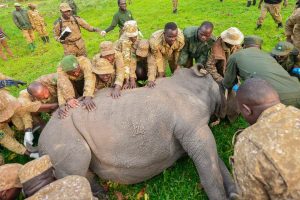
The samples are analysed through UWA’s wildlife laboratory system, including the Biosafety Level 2 laboratory at Mweya in Queen Elizabeth National Park, with the results used to guide treatment and health management.
Dr. Enyel says for example, at Kidepo Valley NP, samples are always taken to wildlife Laboratory system for analysis.
“The samples, once we pick from here, we process from here and then we transport them to Mweya for screening,” he explains.
The genetist warns that maintaining genetic diversity is not simply a matter of keeping a family tree.
The exercise requires specialised veterinary expertise, laboratory testing, careful animal handling and substantial financial resources.
Uganda’s National Rhino Conservation and Management Strategy projected a total budget of about US$10.14 million for rhino conservation over the 10-year period.
The strategy also estimates an average annual requirement of about US$371,044 for biological management for genetic healthy population.
But Dr. Atimnedi cautions that the US$10 million figure represents the cost estimate when the strategy was developed in 2018. And this might not reflect the current economic conditions which have changed, including inflation.
As the population grows and rhinos are established in new locations, veterinary expertise is therefore becoming an increasingly important part of the conservation programme.
A labour-intensive programme
The cost of rhino conservation extends well beyond veterinary care.
Keeping rhinos safe requires personnel working around the clock, along with equipment, transport, surveillance technology, training and other logistical support.
The programme requires rhino monitors who remain with the animals and law-enforcement personnel who patrol the areas day and night.
“You need the rhino monitors who are going to view the rhinos 24-7. You need the law enforcement people who are going to patrol day and night,” Dr. Atimnedi warns.
He adds that the teams also require food, fuel, protective clothing and other equipment because their work continues both during the day and at night.
In the strategic plan, US$131,000 has been earmarked for effective monitoring of rhino population to help the country take informed decision making.
Technology has also become part of modern rhino protection.
UWA uses surveillance tools such as camera traps and GPS equipment, while drones and other technologies can support monitoring and security operations.
Dr. Musinguzi speaking during the launch of the UWA strategic plan 2026-2030 hints at technology driven conservation to modernize conservation and strengthen wildlife protection.
“Our strategic plan will leverage technology including drones, forensic science, GIS and digital system, to strengthen anti-poaching efforts, improve wildlife protection and enhance conservation management.” Dr. Musinguzi said.
But technology alone is not enough.
Personnel must be trained to operate the equipment, interpret information and respond to threats.
Dr. Atimnedi says UWA staff involved in rhino management require specialised training, including exposure to conservation programmes in countries such as South Africa and Kenya.
The staff capacity development has been allocated US$713000 of the total US$10 million for rhino conservation.
Security remains part of the equation
Uganda’s rhinos were lost during decades marked by war, insecurity and widespread poaching. Both Murchison Falls and Kidepo Valley conservation areas still struggling to end illegal poaching up to date.
For Dr. Atimnedi, that history demonstrates how closely wildlife conservation is linked to security and stability.
He cites insecurity in parts of the region, including instability in the Democratic Republic of Congo and South Sudan, movements of refugees, proliferation of small arms and lawlessness as something that can create wider risks for wildlife conservation.
“These things are not good for conservation in general, and for rhinos in particular.” He warns.
The authority says protecting rhinos therefore requires more than wildlife rangers.
However, the Intelligence services, law-enforcement agencies, prosecutors, lawyers, veterinarians, rhino monitors and conservation organisations all have roles to play.
The protection of a small and highly valuable rhino population requires coordination across these different institutions.
The strategic plan allocates US$680,000 for security, protection and law enforcement to secure and protect existing and new population rhinos in Uganda.
Continuous partnerships.
Other than UWA’s board support to the rhino programme by providing funding, while the authority continues to seek additional partnerships.
One recent partnership is Wild Landscapes which has supported the Kidepo rhino programme. Dr. Atimnedi says such kind of partnership makes the financial pressure a little reduced as they continue to source more partnerships.
“They supported us with the fence. They supported us with the vector control or disease control or something. They have given us transport vehicles,” he notes.
Government funding for wildlife conservation has increased over the years. In the Financial Year 2026/2027, the Ministry responsible for Tourism, Wildlife and Antiquities was allocated about US$113 million (UGX421.1 billion), of which approximately US$64.4 million (UGX240 billion) was earmarked for wildlife conservation and protected-area management services.
The allocation represents a 44.2% increase from the previous year, equivalent to about US$19.76 million (UGX73.61 billion).
The authority is nevertheless continuing to seek additional partners and advocate for increased budgetary allocations.
Restoring former Landscapes
Northern and northeastern Uganda were once home to rhinos before the species became extinct in the country.
Eastern black rhinos were common in northern and northeastern Uganda, particularly north of the Nile in areas that included Murchison Falls National Park and Kidepo Valley National Park. By the 1970s, their population was estimated at about 400.
White rhinos, meanwhile, occupied northwestern Uganda, particularly West Nile and West Madi, where about 300 were recorded until the early 1950s.
The devastating civil war, prolonged insecurity and armed poaching contributed to the loss of both species from Uganda.
As Uganda embarks on a full supplementation programme, including plans to translocate rhinos from Ziwa Rhino Sanctuary to suitable habitats in northern Uganda, conservationists are calling for the restoration of the landscapes that historically supported rhinos.
Walter Odokorwot, Executive Director of Umoja Wildlife Conservancies of Uganda says restoring these landscapes could not only create additional space for rhinos but also strengthen genetic connectivity and build trust and support among communities living alongside wildlife.
Odokorwot argues that as Uganda progresses towards achieving the objectives of the National Rhino Conservation and Management Strategic Plan, greater attention should also be given to restoring and securing the former rhino landscapes.
“We have places in Acholi near Murchison Falls NP, these were places for rhinos,” he says this shall allow free movement of the rhinos and cross-breed.
He suggests that community conservancies in former rhino habitats could provide additional space for wildlife while helping reconnect fragmented conservation landscapes.
“That is what needs to be promoted so that rhinos get their own area,” Odokorwot argues.
The conservationist explains that strengthening community-led conservation would enable local communities to become active participants in wildlife protection rather than merely recipients of conservation benefits.
One such initiative in the Acholi sub-region is the Aswa-Lolim Game Reserve, recently established near Pakwach Bridge and covering more than 31,000 acres being managed by community.
Uganda’s rhino comeback has demonstrated that a species once lost from the country can be brought back.
Rewilding, therefore, is no longer simply about bringing rhinos home.
It also requires rebuilding public understanding of the value of wildlife, restoring suitable landscapes and ensuring that communities see themselves as active participants in conservation.
Dr. Atimnedi has rallied the conservation authorities to continually engage communities to build understanding and support for wildlife protection.
“We need to be talking to the communities all the time, so that we cause the attitude change.”
He says such engagement should involve church leaders, opinion leaders, cultural leaders and other influential members of communities.
The conservationists believe that the long-term survival of rhinos will also depend on the attitudes of communities living around wildlife areas.
The issue carries particular significance in northern Uganda, where rhinos once occupied a much wider range.
“We had eastern black rhinos roaming all the way from Murchison into Acholi. Where are they now.?” He asked.
The success of Uganda’s rhino recovery will depend on creating landscapes, institutions and communities capable of supporting the species for generations to come.