

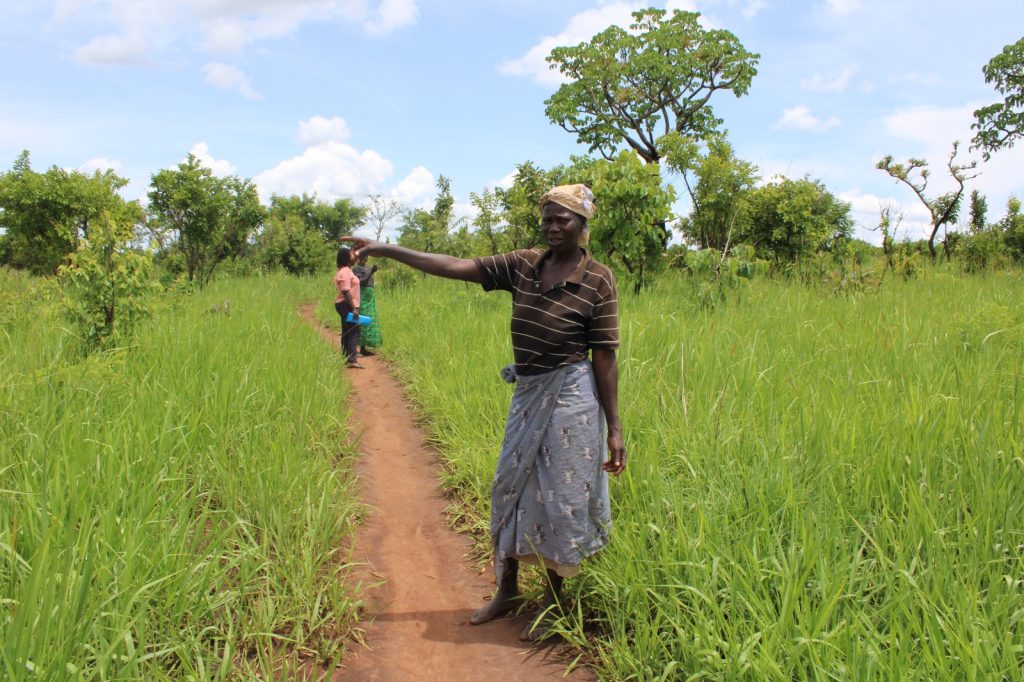
I felt my world ending for the second time after losing my husband,” Molly recalls softly.
By Adong Joanita
Tears rolled down Adoch Molly’s face as she stood helplessly at the edge of the 205-acre piece of land in Lalaloo Village, Ayweri Parish, Paibona Sub-County in Gulu District.
The 53-year-old widow watched in agony as her late husband’s relatives prepared to take over the only source of survival for her family, the land her late husband had left behind for her and their eight children.
“I felt my world ending for the second time after losing my husband,” Molly recalls softly. I kept asking myself where my children and I would go if we lost this land.” She recalls.
After the death of her husband, life already became difficult as she struggled to raise eight children alone. But in December 2024, her pain deepened when her brother-in-law stormed the family land, claiming ownership of it.
Molly says despite repeatedly explaining that she had no intention of selling the land, something she says her in-laws accused her of planning, her brother-in-law returned the following day with his children and began clearing the land in preparation for construction.
The sight shattered her emotionally.
“With tears in my eyes, I ran to local leaders begging for help because I could not afford to lose the only thing my children depended on,” she says.
However, many community members feared involving themselves in the family dispute, forcing Molly to seek help from police and later from organisations supporting women facing land conflicts.
For weeks, fear and uncertainty consumed her life.
“I could not sleep or eat because I was constantly thinking about the future of my children,” she says. “That land is where we get food, school fees, and hope.”
Widespread crisis
Molly’s story reflects a much larger crisis affecting thousands of women across Northern Uganda.
According to research conducted in the region by Women’s Land Rights in Northern Uganda, between 2013 and 2014, nearly 50 percent of people in Northern Uganda experienced land conflicts, with about 72 percent of the disputes occurring within families, households, or clans.
Land remains one of Uganda’s most sensitive social, economic, and political issues because it is the primary source of livelihood for most rural communities. Yet despite women contributing heavily to agriculture, many still lack ownership and control over land.
In rural Uganda, widows often face eviction, intimidation, and property grabbing after the death of their spouses.
Although Uganda’s Constitution guarantees equal rights under Article 21 and protects widows’ rights to inherit and use family property, many women continue to face discrimination in practice.
According to the Uganda Bureau of Statistics (UBOS), women make up nearly 70 percent of Uganda’s agricultural labour force, yet only 27 percent of registered land is owned by women.
In many communities, women cultivate the land, grow food, and sustain families but remain excluded from ownership and decision-making.
UN Women notes that women’s access to land and productive resources is critical in fighting poverty and achieving gender equality. However, weak enforcement of laws, cultural norms, and unequal power relations continue to deny many women control over property.
Ignorance of the Law
For many widows, lack of legal knowledge worsens their vulnerability.
Akello Joyce, a widow to Nyero Bosco, says she spent years battling her brother-in-law, who allegedly wanted to forcefully take over her land simply because she was a woman.
She admits that not understanding her legal rights marked the beginning of her suffering.
“I did not know that I had rights over the land,” she says. “That ignorance gave people confidence to threaten and intimidate me.”
With intervention from local leaders and rights organisations, Akello eventually regained her six acres of land.
According to Lamunu Sharon Topister, a legal advocate working with women affected by land conflicts, many widows in the Acholi sub-region continue to lose property because they are unaware of their rights within marriage and inheritance laws.
“What drives us into this work is the increasing level of land grabbing against widows after they lose their husbands because of their vulnerable nature,” Lamunu explains.
She says many communities still believe that once a husband dies, a woman should return to her parents’ home, even if she had spent years building a life on her husband’s land.
In some cases, relatives of the deceased completely take over family property, especially when widows refuse to be inherited by male relatives.
“The community still has a negative mentality that women are not supposed to own land,” Lamunu says. “Yet the law is very clear that everyone has a right to own property.”
She warns that when women lose land, the consequences extend beyond widows themselves.
“Once women lose their land, they have nowhere to go, leaving not only widows to suffer, but also orphans who are left homeless,” she adds.
Lamunu urges women to embrace joint ownership of property and ensure that land and other family assets are legally documented in both spouses’ names.
“Many women contribute financially toward buying property, but because of submission and cultural expectations, they allow everything to be registered in the husband’s name. Later, when disputes arise, courts rely on evidence, not just stories,” she explains.
She also encourages women to actively participate in land transactions and understand family land boundaries.
“Stop being just a witness when property is being purchased. Be fully involved,” she advises.
Lamunu further warns that women in cohabiting relationships often remain unprotected because inheritance laws mainly recognise legally married spouses.
“Most women today are cohabiting, yet the law mainly protects legally married widows. If your marriage is not legally recognised, it becomes difficult for the law to help you,” she says.
Tradition versus the law
The problem became even more visible in post-conflict Northern Uganda, where many families returned from internally displaced persons’ camps after the Lord’s Resistance Army insurgency only to find themselves trapped in land disputes.
Some families remain displaced from their ancestral homes to this day. Others are stuck in lengthy court battles that drain them emotionally and financially.
Arthur Owor, chairperson of the Gulu City Land Board, says many of the land disputes affecting widows are rooted in patriarchal traditions that continue to favour men in matters of property ownership.
“Many people still view these practices as normal, yet under Uganda’s Constitution, men and women are equal before the law and have equal rights to own property,” Owor says.
He explains that tensions often arise between customary norms and statutory laws. While some cultural practices place men above women in land matters, Uganda’s legal framework guarantees equal rights.
“The challenge is helping communities understand that culture cannot override the law. Women’s rights, including widows’ rights to land, are human rights and must be protected,” he says.
“Land conflicts increased in Northern Uganda after the war when people returned from displacement camps,” says Casemiro Ongom, the Rwot of Patong.
Rwot Ongom noted that many elders who knew the traditional land boundaries died during the insurgency, leaving younger generations uncertain about where boundaries lay.
In Acholi culture, boundaries were often marked by trees, many of which have since been cut down for charcoal burning. “Ongom says communal land ownership and growing land sales have worsened disputes.
He adds that women remain disadvantaged in land matters.
“In Acholi society, women are often seen as having little say over clan land. Traditionally, women accessed land through marriage, and today many still struggle to have their rights recognised.”
Owor also attributes persistent land conflicts in Acholi to the region’s customary land tenure system, where ownership arrangements were traditionally passed down orally rather than documented. The loss of elders who held this knowledge, coupled with displacement caused by the Lord’s Resistance Army insurgency, has increased disputes over land ownership.
He adds that rising land values have intensified competition for land, often leaving widows and orphans vulnerable to dispossession.
“If we are serious about reducing poverty in Northern Uganda, we must address barriers to women’s land ownership because land remains one of the most important resources for livelihoods and development,” he says.
Ongom says communal land ownership and growing land sales have worsened disputes.
“Many people are selling land for quick money and a better lifestyle. At the same time, outsiders are coming to buy large pieces of land, creating misunderstandings that often divide families and end up in court,” he adds.
Patrick Komakech, the LC3 Chairperson of Patiko Sub-County, said most disputes arise from boundary disagreements, greed, and jealousy, which are causing insecurity in the area. The cases are common among family members and close relatives during the farming season.
Komakech noted that many people rush to court instead of seeking mediation through traditional leaders, clan chiefs, and local government authorities.
He noted that many people rush to court instead of seeking mediation through traditional leaders, clan chiefs, and local government authorities.
Komakech appealed to residents to embrace mediation as the best way to resolve land disputes and urged the youth to stop selling family land for personal gain. He called on families to remain united and work together for community development.
A report by the Uganda Land Alliance identifies family land disputes as one of the leading causes of conflict in rural Uganda, with widows and children suffering the greatest consequences.
Despite occasional success stories like Akello’s, many widows across Uganda remain trapped in silent battles hidden behind family conflicts and closed doors.
Restoring Hope
To help prevent further abuses, organisations supporting widows have started partnering with local leaders to conduct community dialogues on women’s land rights and the dangers of property grabbing.
Aber Patience, a liaison officer at Redeem International, says the organisation has been working with communities affected by land conflicts across Northern Uganda.
“So far, 33 widows and their beneficiaries have been restored to their land over the past five years,” she explains.
According to Aber, the organisation uses different approaches to resolve disputes, including mediation, court processes, court orders, and collaboration with local council leaders and sub-county structures.
“We mainly focus on civil land cases because many families lack access to justice,” she says.
She adds that recent research conducted by the Organisation indicates a slight decline in land grabbing cases in some communities we have worked with, suggesting that awareness campaigns are slowly changing attitudes.
“People are beginning to understand the legal and social consequences that come with land grabbing,” Aber explains.
For Adoch Molly, months of mediation and legal intervention eventually brought justice.
Her land was peacefully restored, giving her children a future once again.
“Today, I can smile again because my children have a place to call home,” she says with relief. “I now believe widows also deserve justice.”
This story was done with support from Northern Uganda Media Club (NUMEC).







One Response