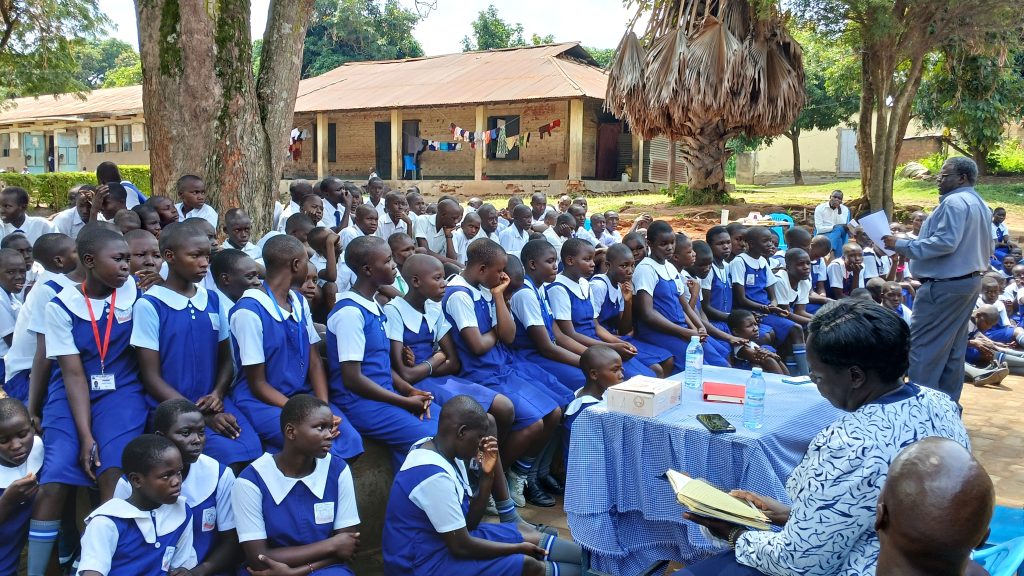
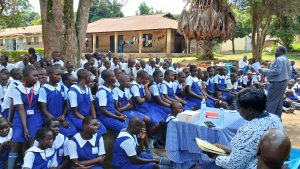
Pupils during lunchtime assembly at Arua Hill Primary School scale
Research from refugee contexts across Africa shows that many women and girls lack access to toilets with locks, clean water, lighting, and discreet disposal systems.
By Teddy Dokotho
Before the sun rises, 17-year-old Nyabothtot Maria quietly prepares for another school day inside one of Uganda’s refugee settlements. The small shelter she shares with her family is already awake, but unlike many of her classmates, Maria is not rushing to beat the morning bell. Her menstruation started during the night.
Instead of thinking about the mathematics lesson awaiting her in Senior Two, Maria is calculating whether the packet of sanitary pads her mother bought at the beginning of the month will last until her menstruation ends.
“I always worry when my menstruation starts. My mother buys me one packet of pads every month, but sometimes it is not enough because my menstruation lasts about four days. When the pads get finished before my menstruation ends, I use pieces of cloth until it stops,” she says quietly.
It is a decision no teenager should have to make.
Maria fled conflict in South Sudan with her family several years ago. Like thousands of refugees who sought safety in Uganda, she escaped war hoping for a better future. Today, education represents that future.
Yet every month, another struggle interrupts her journey not because menstruation is abnormal, but because displacement has made managing a natural biological process far more difficult.
Her story reflects the reality of thousands of refugee girls and women across Uganda and the wider Global South, where humanitarian assistance rightly prioritizes food, shelter, healthcare and protection, but menstruation is still too often treated as a secondary concern.
Even when addressed, the focus usually remains on distributing sanitary pads and promoting menstrual hygiene. But is menstruation simply a hygiene issue?
The Global South Coalition for Dignified Menstruation argues that it is not. It defines menstrual discrimination as the silence, stigma, restrictions, exclusion, violence, and deprivation of services and resources experienced by menstruators throughout their lives simply because they menstruate.
For girls living in humanitarian settings, displacement often magnifies these inequalities. Conflict strips families of income, interrupts education, weakens community support systems and stretches humanitarian resources, making menstruation yet another barrier for girls already coping with the trauma of displacement.
Maria vividly remembers her first menstruation.
“I was still in primary school. It started while I was at school. I became scared because I didn’t know what was happening. I immediately ran home and told my elder sister. At that time, I knew nothing about menstruation.”
Her experience mirrors that of many girls who reach menarche without adequate information. In humanitarian settings, where families and social support networks are disrupted, the silence surrounding menstruation can be even more profound.
Today, Maria understands her menstrual cycle, but knowledge alone has not removed the obstacles she faces.
“Every month I experience severe stomach pain when my menstruation starts. Sometimes I arrive late for school because of the pain.” Even after reaching school, another fear begins,” she says.
“I wear extra pants because I am afraid the pad might leak. At school, there is no private place where you can change comfortably without someone disturbing you. I don’t want other people to know that I am on my menstruation”
Her fears are shared by many adolescent girls living in refugee settlements. Menstruation is not only about managing bleeding, it is about managing fear, anxiety, embarrassment and the possibility of exclusion.
These experiences reveal a reality that humanitarian responses often overlook. The challenge is not merely the shortage of sanitary pads or inadequate toilets. It is menstrual discrimination a web of social, cultural and structural barriers that deny menstruators dignity, privacy, participation and equal opportunity.
That raises an important question, are humanitarian responses protecting menstrual dignity, or are they simply managing menstruation?
Answering that question requires looking beyond the contents of a dignity kit. It means asking whether refugee menstruators are able to enjoy their rights to dignity, health, education, bodily autonomy, information, participation, water and sanitation, and freedom from discrimination.
The Global South Coalition for Dignified Menstruation proposes five indicators for answering that question: Products, Privacy, Places, Participation and Power.
Viewed through these five pillars, the experiences of refugee girls reveal that menstrual discrimination extends far beyond access to menstrual products.
Fifteen-year-old Gloria (not her real name), a Primary Seven pupil living in a refugee settlement, faces many of the same challenges.
“Sometimes my mother is able to provide me with pads, but other months she cannot because of poverty, I want pads because I need them to attend classes.” she says. “
When menstrual products become a privilege rather than a guarantee, girls are forced to improvise with pieces of cloth or other unsafe alternatives, compromising both their health and dignity.
Yet products are only one part of the picture.
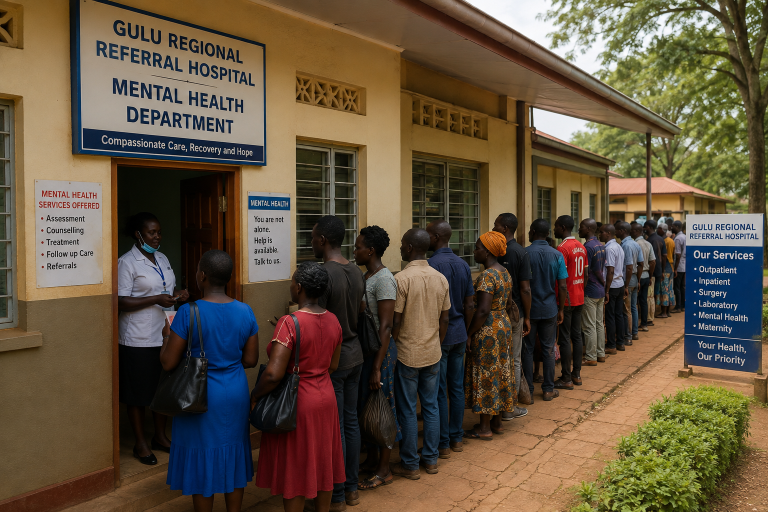
Dignified menstruation also requires safe and accessible places where girls can wash, change and dispose of menstrual materials privately. Across many refugee settings, toilets lack locks, lighting, water or proper disposal facilities. Overcrowding further limits privacy.
For many girls, the result is painful choices. Some stay home during their menstruation to avoid embarrassment. Others reduce the amount of water they drink to avoid using school toilets.
These are not simply sanitation challenges. They are signs that dignified menstruation remains out of reach for many refugee menstruators. The question, therefore, is no longer whether humanitarian actors should distribute menstrual products.
The bigger question is whether humanitarian systems are confronting the discrimination that prevents refugee girls from managing menstruation with dignity.
Schools, society, and the fight against menstrual discrimination
For many refugee girls, menstruation affects more than their monthly routine; it shapes whether they attend school, participate in class, and feel confident enough to pursue their education.
Recognising this, some schools are working to create environments where menstruation is treated as a normal part of life rather than a source of shame.
At Arua Hill Primary School, Head Teacher Adiru Beatrice Asimasia says the school has introduced several initiatives to support girls, including emergency sanitary pads, teacher-parent mentorship, peer support groups, and menstrual health education.
“The girl child is our priority; what they cannot get at home, they are able to get at school” she says.
Parents are encouraged to discuss menstrual health with their daughters, while teachers provide guidance to girls experiencing puberty. Perhaps most significantly, boys are also encouraged to support rather than shame their female classmates.
“When a girl’s uniform is stained, sometimes it is the boys who report it so she can receive help,” Asimasia explains.
She believes creating a supportive school environment has contributed to improved retention of girls, demonstrating that addressing menstrual discrimination requires more than providing sanitary pads it demands changing attitudes and building systems of care.
Biology teacher Matua Job Richard agrees that ending menstrual discrimination begins with changing community perceptions.
“The menstrual cycle is of biological significance. If your daughter begins menstruating, it means she is developing normally,” he says.
He believes fathers should take greater responsibility for supporting their daughters by providing menstrual products and emotional support rather than treating menstruation as an issue that belongs only to women.
His message reflects one of the central principles of dignified menstruation, ending menstrual discrimination requires the involvement of parents, teachers, boys, men, community leaders, humanitarian workers and policymakers.
Yet many schools, particularly those serving refugee communities, continue to face significant challenges.
A 2021 assessment by the AVSI Foundation under the USAID-funded Graduating to Resilience project found that inadequate menstrual waste disposal facilities, limited access to water, and a lack of private spaces for washing and drying reusable pads continue to affect girls in schools and refugee settlements.
The study found that the absence of proper disposal facilities contributes to school absenteeism among menstruating girls, highlighting the need for gender-responsive WASH infrastructure that protects girls’ health, dignity and education.
Menstrual discrimination
For Dr. Radha Paudel, founder of the Ms. Radha Foundation and a global advocate for dignified menstruation, the biggest misconception in humanitarian response is that menstruation is simply a hygiene issue.
“The biggest challenge is not menstruation itself it is menstrual discrimination,” she says.
According to Dr. Paudel, becoming a refugee does not stop menstruation. Instead, displacement deepens the unequal power relations, patriarchy and exclusion that many menstruators already experience.
“Society, including state institutions, often treats menstruators as inferior, powerless or incapable simply because they menstruate,
“As a result, they are frequently excluded from decision-making, policy formulation, budgeting and programme implementation, and are viewed as victims rather than active agents of change.” she explains.
She argues that this exclusion leaves menstruators without adequate protection, information, menstrual products or gender-responsive WASH facilities, increasing their vulnerability in humanitarian settings.
“When menstruators are left out of planning and decision-making, proactive and protective mechanisms are often missing,” she says. “Conditions such as menstruation, pregnancy and menopause can further push women and girls to the margins and expose them to additional forms of sexual and gender-based violence.”
For Dr. Paudel, humanitarian agencies should move beyond asking whether menstrual products are available and instead ask deeper questions: Who is involved in planning humanitarian responses?
Are menstruators represented in decision-making? Are budgets allocated for their specific needs? Are programmes designed to recognise the diverse experiences of adolescent girls, pregnant women and women experiencing menopause?
She argues that humanitarian programming should be guided by the Three Ps when selecting menstrual products: Person, ensuring menstruators are free from discrimination; Planet, promoting environmentally sustainable products; and Pocket, ensuring products remain affordable without compromising quality.
Likewise, she says water, sanitation and hygiene facilities should be safe, accessible, stigma-free and designed to protect both the dignity and safety of menstruators.
“Mainstreaming dignified menstruation is everyone’s business from the United Nations to local communities, governments, humanitarian organisations, universities, the media and community leaders,” she says.
Although many humanitarian programmes promote gender equality and include menstrual products in relief packages, Dr. Paudel believes they often fail to confront the structural inequalities that drive menstrual discrimination.
“Recognition of menstrual discrimination is still missing, as a result, we continue repeating the same mistakes over and over again,” she says.
She argues that true progress will come only when humanitarian responses move beyond distributing menstrual products to dismantling menstrual discrimination itself.
“Dignified menstruation is not only about managing menstruation; it is about transforming humanitarian systems so that every menstruator can live with dignity, equality, inclusion, and the power to participate in decisions that affect their lives,” she says.
Beyond Hygiene:
Research from refugee contexts across Africa shows that many women and girls lack access to toilets with locks, clean water, lighting and discreet disposal systems. Even where sanitation facilities exist, overcrowding and poor maintenance limit their usability.
The absence of safe disposal facilities means many girls choose to remain at home during menstruation rather than risk embarrassment.
Others reduce the amount of water they drink during the day to avoid using school toilets altogether. These are not merely sanitation problems. They are indicators that dignified menstruation is not yet being fully realized.
Uganda has made progress in promoting adolescent health and menstrual hygiene through broader reproductive health, school health and WASH programmes. However, the country does not yet have a standalone national policy or strategy dedicated to menstrual health or dignified menstruation.
This policy gap is particularly evident in refugee settlements, where humanitarian partners provide much of the support for menstrual health.
Solomon Osakan, the Refugee Desk Officer for West Nile Region at the Office of the Prime Minister (OPM), says menstrual health interventions are largely funded and implemented by humanitarian organisations rather than government.
“The Office of the Prime Minister does not have a specific budget for menstrual health and hygiene,Partners implementing gender-based violence programmes and initiatives supporting girls’ education usually allocate resources for menstrual health activities.” Osakan says.
He says many partners integrate menstrual health into broader protection and education programmes by constructing gender-segregated WASH facilities in schools and communities to provide girls with private spaces to manage their menstruation.
“When WASH facilities are constructed, they are designed with separate facilities for girls,” he explains. “There is always a bathroom or washroom where girls can manage menstruation in privacy.”
Schools also play an important role. Senior women teachers provide menstrual health education, counsel girls experiencing puberty and help identify cases of sexual abuse that require intervention.
Osakan notes that menstrual product support has evolved over time. In the past, Makerere University, through the MakaPads initiative, produced affordable sanitary pads for refugee communities. Today, several humanitarian organisations train refugee women and girls to manufacture reusable sanitary pads through community groups, improving both access and livelihoods.
He adds that UNHCR previously distributed sanitary pads to newly arrived refugee women and girls of reproductive age, while some assistance has shifted towards cash-based support. However, humanitarian agencies remain concerned that competing household needs may mean cash intended for menstrual products is used for other essentials.
Despite these efforts, Osakan believes menstrual health remains essential to girls’ education.
“It is a very important activity in the settlement to ensure that girls continue to study and are not inhibited by menstrual hygiene,” he says.
His remarks illustrate both the progress made through humanitarian partnerships and the continuing dependence on donor-funded programmes. Without dedicated public financing, many interventions remain vulnerable to funding cycles and shifting humanitarian priorities.
For advocates of dignified menstruation, this raises a broader question: Is humanitarian response protecting menstrual dignity, or simply managing menstruation?
The answer lies not only in the availability of sanitary pads, but in whether refugee menstruators can enjoy their fundamental rights to dignity, health, education, participation, bodily autonomy, information, water and sanitation, and freedom from discrimination.
The Five Pillars of Dignified Menstruation Products, Privacy, Places, Participation and Power offer a practical way to measure that reality.
For Maria, those pillars remain incomplete.
She still worries every month about whether her pads will last. She still arrives late for school because of severe menstrual pain. She still wears extra clothing to avoid the embarrassment of leaking. She still fears changing her pad at school because privacy is limited and disposal facilities are inadequate.
Her story is not an isolated experience. It reflects the daily reality of thousands of refugee girls across Uganda and the Global South whose education, health and confidence continue to be shaped by menstrual discrimination.
Ending that discrimination will require more than distributing menstrual products.
It demands humanitarian systems that recognize menstruation as a matter of dignity, equality and human rights. It requires governments to strengthen policies, allocate dedicated resources and integrate dignified menstruation into national and humanitarian planning.
It calls on humanitarian agencies to involve menstruators in decision-making, ensuring programmes reflect their lived experiences rather than assumptions about their needs.
Communities, schools, parents and boys also have a role to play by challenging harmful myths and creating environments where menstruation is understood as a normal part of life rather than a source of shame.
As conflicts, climate shocks and humanitarian crises continue to displace millions of people across the world, one question remains. If humanitarian responses are designed to protect human dignity, can they truly succeed while overlooking the dignity of those who menstruate?
For girls like Maria, the answer will determine more than how they manage a monthly cycle. It will shape whether they can learn, participate, lead and build the futures they imagined long before conflict forced them from home. Because dignified menstruation is not a privilege. It is a human right.