This is one of the lorries impounded along the Gulu-Nimule Highway in Amuru district during one of the crackdown operations by the security.
Maj. Gen. Busizori said authorities had received information alleging that proceeds from the charcoal trade were being channelled to the South Sudan-based SPLA-IO rebel group.
By Willy Chowoo
Gulu City—The UPDF 4th Division has ordered an immediate halt to the cross-border charcoal trade between South Sudan and Uganda, citing security concerns.
The 4th Division Commander, Maj. Gen. Felix Busizori, issued the orders on Tuesday, August 11, 2026, during a meeting with charcoal dealers at the division headquarters in Gulu City.
Maj Gen Busizori handed about 40 charcoal dealers over to police for investigation and directed the Uganda Revenue Authority (URA) to stop clearing charcoal consignments entering the country.
He said the decision followed continued defiance of a presidential directive banning charcoal business in northern Uganda, allegations of corruption at security checkpoints, and concerns that the cross-border trade is being used to circumvent Uganda’s environmental restrictions.
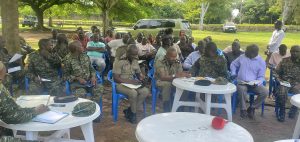
“Effective today, no more transportation of charcoal on Ugandan land. If it is passing on the land of Uganda, it is illegal,” Busizori told the traders.
The presidential directive banning charcoal burning and commercial charcoal trade in Northern Uganda is contained in Executive Order No. 2023, issued by President Yoweri Museveni on May 19, 2023.
The order covers Northern and Northeastern Uganda, specifically Acholi, Lango, Teso, West Nile and Karamoja. The president linked the ban to deforestation and environmental degradation, including the cutting of valuable indigenous trees such as shea trees.
The UPDF is enforcing President Museveni’s 2023 ban on charcoal burning and commercial trade in Northern Uganda, with the security forces now targeting traders and transporters allegedly using the region as a corridor for charcoal, including charcoal origination form South Sudan.
Now, the UPDF has ordered the police to investigate the traders’ involvement in the charcoal trade, as well as the people facilitating the movement of the consignments.
In 2025, the Resident District Commissioners (RDCs) of Lamwo and Amuru districts reported that although local commercial charcoal production had declined, charcoal entering from South Sudan remained a challenge.
Maj Gen Busizori said security agencies had repeatedly intercepted charcoal trucks but alleged that traders had exploited corruption at checkpoints by bribing soldiers and police officers to allow the consignments through.
The army chief also ordered investigations into charcoal activities, which are still rampant in Uganda bordering districts of Moyo, Yumbe, Koboko, and other areas affected by the trade.
The investigations, he said, should not stop with the traders but should extend to officials from the National Forestry Authority (NFA), Police, UPDF and other agencies responsible for regulating the movement of forest products.
“All of them must be investigated, and we go to the bottom of this problem. Whoever is involved, whether you are or not, you will be held responsible,” Busizori warns.
Officials from URA have acknowledged that there had been cases of alleged corruption involving the alleged manipulation of customs seals.
This was a case involving a charcoal truck, which was later investigated, and the person involved has been terminated, according to the URA Manager of Customs for Northern Uganda.
Tumwesigye Simon has urged the security agencies to provide URA with details of any other trucks suspected of using fraudulent seals so that the authority could investigate them.
Large-scale charcoal activities involving highly connected dealers are currently taking place in Zoka Central Forest Reserve in Adjumani district, where the indigenous trees are being depleted.
URA ordered to stop charcoal clearance.
Maj Gen Busizoori’s directive didn’t stop with Uganda Police only; he also directed Uganda Revenue Authority (URA) to stop clearing charcoal consignments entering Uganda from South Sudan until the legality of the trade is clarified with the South Sudan government.
He said Uganda could not continue allowing charcoal to cross its territory when questions remained over whether the trade was authorised in South Sudan.
Tumwesigye told the meeting that the cross-border charcoal trade had previously been stopped after Uganda’s charcoal ban was introduced.
However, he said traders and South Sudanese authorities later petitioned the 4th Division, leading to the reopening of the trade under a verification arrangement.
Tumwesigye said traders were required to obtain documentation from the relevant authorities in South Sudan before URA could clear the consignments.
This directive also applies to charcoal transported within Ugandan territory, regardless of where it was produced, and those who defy it will have their trucks impounded if found transporting charcoal.
Maj Gen Busizori said the impounded charcoal would not necessarily be auctioned but could instead be distributed to communities affected by environmental degradation and food insecurity.
Security concerns over charcoal trade
The crackdown also follows security concerns raised over the cross-border charcoal business.
Maj. Gen. Busizori said authorities had received information alleging that proceeds from the charcoal trade were being channelled to the South Sudan-based SPLA-IO rebel group.
He said the allegations, together with questions surrounding the authenticity of some documents used to clear charcoal, warranted investigation.
The commander said authorities had previously received information that traders were using gaps along the Uganda-South Sudan border to continue a business prohibited in northern Uganda.
The army accuses some traders of shifting their operations to South Sudan after Uganda imposed the charcoal ban but continued transporting the product through Uganda.
However, the traders have disputed the allegation that they were violating Uganda’s presidential directive. “Our charcoal comes from South Sudan,” traders explain.
Dorcus Okello, chairperson of a group of charcoal dealers operating between Uganda and South Sudan, said the traders were aware of the ban and had moved their operations across the border after it was imposed.
She said they do not burn charcoal in Uganda but purchase it from South Sudanese producers and transport it into Uganda after obtaining documents and paying taxes and fees to authorities in both countries.
“The authorities, they have failed to separate us who are operating from South Sudan with maybe those who are violating the law operating from within the country,” Okello said.
Okello said the traders use designated loading points in South Sudan and have previously undergone verification by Ugandan and South Sudanese authorities.
Tumwesigye, however, supported this by saying that the verification teams had previously travelled to loading points in South Sudan to establish the origin of the charcoal and develop a system for verifying consignments.
She appealed to the security agencies to distinguish between traders importing charcoal from South Sudan and those producing charcoal illegally inside Uganda.
The traders also said they had invested heavily in the business and were servicing loans, warning that the immediate stoppage would leave charcoal already purchased across the border stranded.
NFA questions the legality of South Sudan charcoal.
The National Forest Authority in Uganda has raised concern as well over the legality of the wood products entering the country from South Sudan.
NFA Senior Forest Officer for Acholi sub-region, Ojja Michael Vuloy, questioned whether the charcoal entering Uganda from South Sudan was being legally produced and exported.
Ojja warned Ugandan authorities against facilitating environmental destruction in South Sudan and questioned whether restrictions on charcoal exports from South Sudan had been lifted.
He also alleged that some charcoal being presented as South Sudanese imports could actually be produced along the Ugandan side of the border and disguised as foreign consignments.
He further alleged that some documents presented by traders were forged.
“These guys need to be investigated. We need to get to this matter so that Uganda is not held liable for destruction of our forest reserves in South Sudan,” Ojja said.
Crackdown could disrupt regional trade.
The latest order could bring the cross-border charcoal trade through northern Uganda to a halt, despite traders insisting that their operations are legitimate imports from South Sudan.
It also exposes a long-running enforcement gap involving several government agencies.
URA said it clears consignments after relevant agencies verify their origin and documentation, while NFA questioned the legality and authenticity of some of the documents.
Maj. Gen. Busizori said the crackdown was also necessary to protect forests in northern Uganda and neighbouring South Sudan, warning that continued destruction of forests would have consequences for communities on both sides of the border.
For the charcoal dealers, Tuesday’s meeting marked a dramatic reversal from the earlier arrangement that had allowed them to transport charcoal from South Sudan through Uganda.
For the security authorities, however, the message was unequivocal: the cross-border charcoal trade is stopped, and those suspected of facilitating it will now face investigation.