When the programmes stopped, many of those services disappeared almost overnight.
By Teddy Dokotho
Gulu City.
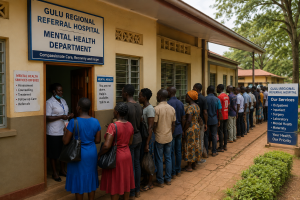
Every morning, health workers across facilities in Gulu City comb through patient records looking for people who have missed their HIV treatment appointments.
Some simply forgot or changed their phone numbers; a few have not been seen for months. However, for health workers, these are not just names on a register; they are patients whose lives depend on taking antiretroviral drugs every day.
In recent years, finding and bringing these patients back into care has become much harder.
The challenge emerged after several donor-supported community programmes that helped keep HIV patients connected to treatment were abruptly disrupted, leaving health facilities scrambling to fill the gap.
“We experienced many lost clients, not because drugs were unavailable, but because the support systems that helped patients remain in care suddenly stopped,” said HIV Focal Person for Gulu City . Florence Amito.
For years, HIV programmes in Gulu relied heavily on outreach workers, community linkage personnel, and support staff funded through partner organisations. They followed up with patients who missed appointments, delivered medicines closer to communities, and sometimes provided transport support for those unable to reach health facilities.
When the programmes stopped, many of those services disappeared almost overnight.
“Most of the people who were doing follow-up and taking medicines into communities were supported by those organisations. “When they stopped, we immediately started seeing challenges,” Florence explains.
The interruption exposed a reality often overlooked in discussions about HIV treatment: medicines alone are not enough.
While HIV drugs remained available in health facilities across Gulu, many patients struggled to maintain regular access to care without the support systems that helped them navigate the challenges of treatment.
“The good thing was that we never experienced stock-outs of ARVs. The medicines were there. The challenge was reaching the people who needed them,” Florence says.
The situation is particularly concerning in Gulu City, where HIV prevalence remains significantly higher than the national average.
According to city health data, Gulu’s HIV prevalence stands at 9 percent compared to Uganda’s national prevalence of 7 percent.
An estimated 22,439 people are currently living with HIV in the city.
Between January and March this year alone, health facilities recorded 480 new HIV infections.
For health officials, these numbers represent more than statistics. They highlight the importance of ensuring that every person diagnosed with HIV remains connected to treatment services.
Under Uganda’s current HIV treatment guidelines, anyone who tests positive is encouraged to start treatment almost immediately.
Unlike previous years when patients had to wait until their immune systems weakened before beginning treatment, the current approach is known as “test and treat.”
“When someone tests positive today, we encourage them to start treatment as soon as possible,” Florence explains. We usually give them a few days to process the diagnosis before beginning treatment. “Once treatment begins, it is expected to continue for life.
Missing medication can allow the virus to multiply, weaken the immune system, and increase the risk of transmission.
That is why health workers are increasingly concerned about patients who disappear from care.
At Bardege Health Centre III, health workers have developed new strategies to track and support patients who miss appointments.
Dr. Stella Ayaa, the facility’s in charge, says the health centre now relies on trained community linkage facilitators to identify patients at risk of dropping out of care.
“Every day we review our records and identify people who are due for refills and those who have missed appointments,” she says.
The facilitators then call patients, send reminders, or visit their homes in person when necessary.
“Sometimes we call them before their appointment and remind them,” Dr. Ayaa explains. “If they miss, we try to reach them by phone. If that does not work, we go to the community and look for them.”
The strategy has helped reduce the number of patients lost to follow-up, but health workers admit it remains a challenge without the level of support that previously existed.
Beyond treatment retention, health officials are also concerned about the factors driving new infections. Young women and girls continue to carry a disproportionate burden of HIV in Gulu City.
Among adults aged between 30 and 49 years, women account for more than twice as many HIV cases as men. Similar patterns are visible among younger age groups.
For Dr. Ayaa, the reasons are not difficult to identify. Many young women face economic hardship, peer pressure, and limited opportunities.
“Some young girls see their friends receiving financial support from partners, and they also want the same lifestyle,” she says. Others, she adds, turn to transactional sex because of poverty.
Economic vulnerability remains one of the most significant drivers of HIV risk among adolescent girls and young women in the region. Alcohol and substance abuse are also contributing factors.
“When young people get involved in alcohol and drugs, it affects their judgment,” Dr. Ayaa says. “They may engage in risky sexual behaviour that increases their chances of acquiring HIV.”
Health officials are equally concerned about the number of children and adolescents living with the virus.
City records show that hundreds of children and teenagers are currently receiving HIV treatment, underscoring the continuing challenge of preventing new infections and supporting affected families.
To address these challenges, the Ministry of Health has introduced a more integrated approach to service delivery. Instead of conducting separate outreach activities for different health programmes, health teams now combine services during community visits.
The aim is to maximise the use of limited resources while ensuring that communities continue to receive essential healthcare.
Health workers also continue conducting outreach activities in identified hotspots across the city, including areas associated with commercial sex work and other high-risk populations.
Despite the obstacles, Gulu City’s HIV response has achieved some important successes.
Of the 480 people newly diagnosed between January and March this year, 96 percent were successfully linked to treatment and care services.
Health officials also report viral suppression among 89 percent of patients enrolled on treatment, meaning the virus has been reduced to levels that significantly improve health outcomes and lower the risk of transmission.
Still, Florence believes sustaining these gains will require more than medicine.
“People living with HIV need support; they need follow-up, and they need counselling reminders. They need someone who can reach them when they miss appointments,” she says.
As Gulu City continues to battle one of the highest HIV prevalence rates in the country, the experience of recent years has revealed a critical lesson.
The fight against HIV is not only about ensuring drugs are available on clinic shelves. It is also about maintaining the community networks that help patients stay connected to care. Without those networks, health workers warn, many patients risk being left behind.