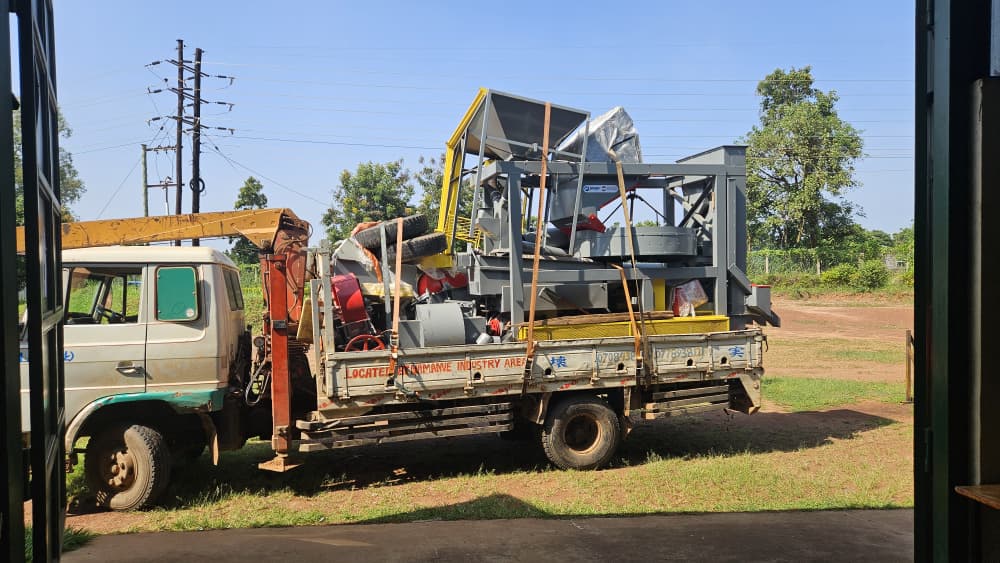
The coffee huller machine arriving at the district headquarters at Kanyagoga C cell, Bardege-Layibi division, Gulu city
The newly acquired coffee huller—capable of processing up to 1.5 tonnes per hour—is the first of its kind in Acholi sub-region.
By Willy Chowoo
Gulu City—A gradual but impactful shift is emerging across Northern Uganda’s agricultural landscape, as the Ministry of Agriculture, Animal Industry and Fisheries (MAAIF) hands over a coffee huller machine to the Diocese of Northern Uganda—marking a new chapter in the region’s journey from subsistence farming to value-added production.
The machine, unveiled at the diocesan offices in Gulu City on Thursday, is expected to play a critical role in processing coffee beans, allowing farmers to fetch better prices and compete on export markets.
For decades, coffee has not been a traditional cash crop in Acholi and the wider Mid-North region. Farmers largely depended on crops like cotton and tobacco as the main cash crops for the region. But a deliberate shift is now underway.
Government is scaling up a new coffee frontier. Targeting the distribution of 20 million plus coffee seedlings.
Twine Julius, Senior Agricultural Officer at the Ministry of Agriculture, Animal, Industry and Fisheries (MAAIF), overseeing 17 districts in Acholi and Lango, says the government is rolling out an ambitious plan to turn Northern Uganda into a key coffee-producing zone.
“We are addressing the entire value chain—from production to processing and returns,” he explained. “This machine is part of that bigger plan. Farmers have planted, and in the next two to three years, we expect significant volumes of coffee that will require processing.”
Under the programme, MAAIF—working with Operation Wealth Creation (OWC) and local partners—has already distributed millions of seedlings across Northern Uganda. Last season alone, about 24 million seedlings were allocated to the region.
The goal is to cultivate at least 150,000 acres of coffee and position Northern Uganda as a major contributor to Uganda’s coffee exports, which currently total about 8.6 million bags annually and earn the country over $2.3 billion.
Currently, there are more than 5000 registered coffee farmers in the Acholi sub-region.
The government introduced Coffee growing in Acholi in 1999 as an alternative cash crop to cotton, in a bid to fight household poverty.
Value addition at the doorstep
The newly acquired coffee huller—capable of processing up to 1.5 tonnes per hour—is the first of its kind in Acholi sub-region. It will enable farmers to carry out primary processing locally, removing husks and preparing beans to export grade.
“This is not just for the diocese,” Julius emphasised. “It will serve farmers across the sub-region—helping them bulk, add value, and sell better-quality coffee.”
For farmers who have long sold raw produce with minimal returns, the machine represents a shift in economic power.
The machine will now be the second to the one previously given by the ministry to the Lango sub-region, currently installed at Loroo in Oyam District.
For the Diocese of Northern Uganda, the coffee initiative is rooted in a broader vision of community transformation.
Rev. Aber Caroline, the diocesan coordinator for households and community transformation, recalled how the idea began two years ago as a faith-driven mission to fight poverty.
“We started planting coffee by faith, even when we didn’t have a processing machine,” she said. “Today, God has answered our prayers.”
Aber believes the initiative will not only improve incomes but also change perceptions about Acholi.
“We are tired of being called the poorest region. Coffee is going to boost incomes and transform lives,” she added.
The Bishop of the Diocese of Northern Uganda, Rt. Rev. Godfrey Loum, described the machine as a “blessing” and urged farmers to embrace coffee growing more seriously.
Between 2025 and 2026, the diocese has already distributed close to 6,000 seedlings across communities—without religious discrimination.
“Now farmers have the capacity to process their coffee,” he said. “This should be the end of selling unprocessed coffee. Bring it here, add value, and earn more.”
The diocese is also setting up a mother garden at its farm to produce its own seedlings, ensuring sustainability and continuous expansion of coffee farming.
Atiko Walter, the chairperson of the Diocese of Northern Uganda Cooperative Society, expects the garden to address the challenge of coffee seedlings. It will comprise coffee seedling varieties, from K1 to K10,” Atiko adds.
The mother garden is located at the diocese farm in Bardege-Layibi Division in Gulu City.
Atiko says the diocese shall set up a very big storage facility for the coffee that shall be purchased by the diocese,
Climate-smart farming key to success
Even as enthusiasm grows, experts caution that success will depend on proper agronomic practices and climate adaptation.
MAAIF is urging farmers to plant early—between March and June—so crops establish before the dry season. Intercropping with bananas and maintaining shade trees are among the climate-smart practices being promoted to improve survivability.
“We must ensure the coffee survives,” Julius stressed. “With the right practices, Northern Uganda has proven it can produce high-quality coffee.”
However, most of the small-scale farmers trying to move from subsistence farming to commercial farming are already finding difficulty in transitioning to climate-smart practices due to the cost involved and the knowledge gaps.
Atiko Walter says currently they are training farmers on basic smart practices, such as watering their garden in the early morning and later in the evening.
“We are training farmers on how to respond to challenges, including using dry grass mulching, digging standard holes for coffee, and watering at the right time to withstand the dry spells,” he notes.
Brewing a new economic identity
As the first coffee huller in Acholi begins operations, it symbolises more than just a machine—it represents a shift in mindset, from subsistence to commercial agriculture, from raw sales to value addition.
If the current momentum is sustained, Acholi sub-region could, within a few years, redefine itself—not as a region recovering from past hardships—but as an emerging powerhouse in Uganda’s coffee economy.
For now, the message to farmers is clear: plant, nurture, process—and prosper.