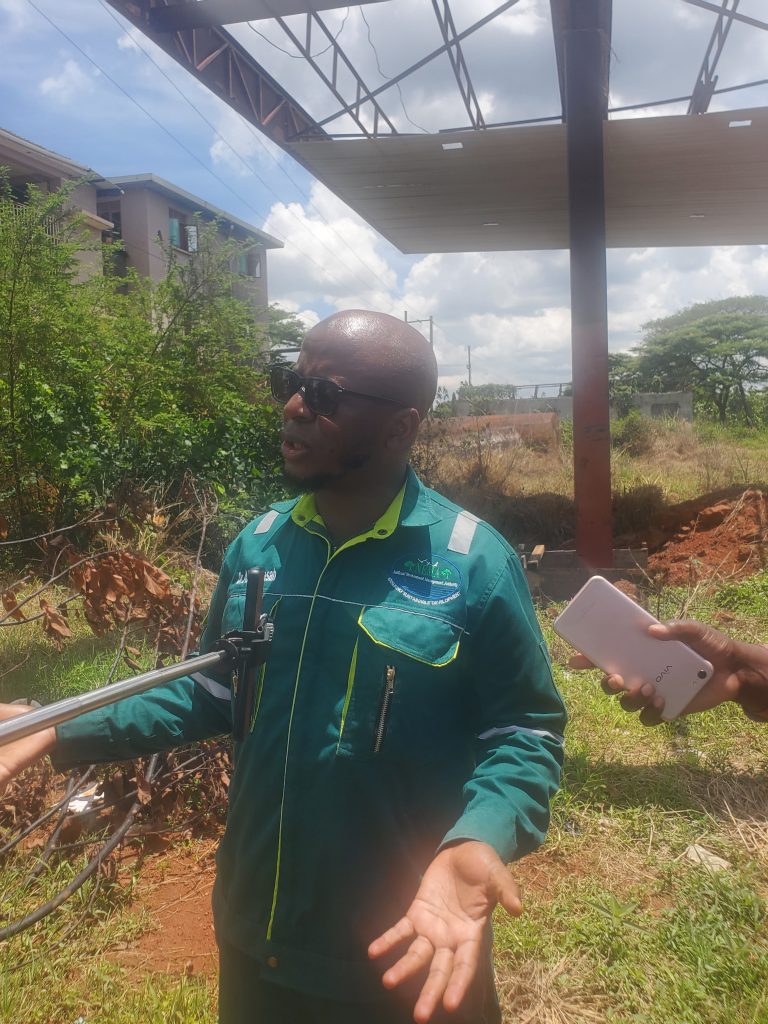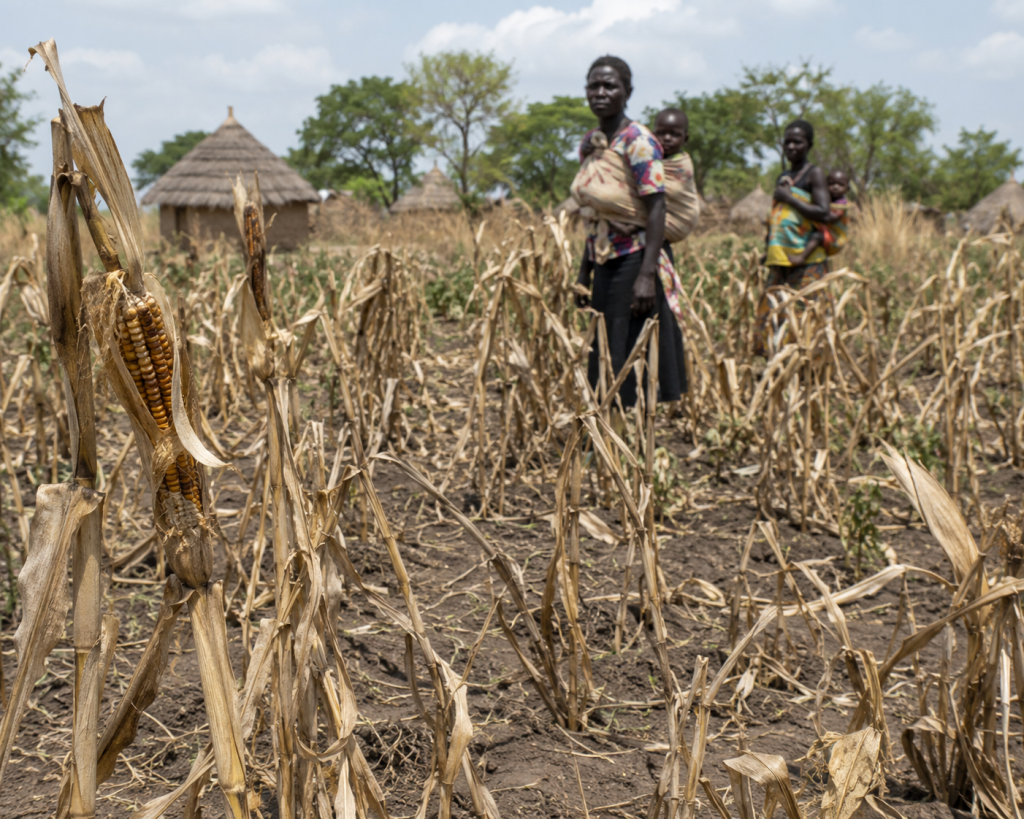
Many farmers cite the high cost of inputs, such as weather-resistant seeds, irrigation systems, and solar-powered equipment, as a major obstacle.
By Willy Chowoo
Gulu City—When Odokonyero Francis (Reverend) borrowed three million Ugandan shillings in an agricultural loan from the bank to invest in farming, he hoped to turn his fortune around. Instead, the small-scale farmer from Ajan North village in Odek Sub-County, Omoro District, is now counting losses after successive seasons of poor yields driven by harsh weather conditions.
Determined to improve his income, Odokonyero opened up 8 acres of land and planted soybeans in late April of the first season of 2025. With good rains expected, he projected he would harvest at atleast 40 bags.
However, the prolonged dry spells hit the area, leaving his crops struggling to survive. This was when his soybeans were about to begin flowering.
“I expected 40 bags, but I only harvested five,” he says.
After selling the produce, Odokonyero earned just sh850,000, far below what he needed to repay the loan and support his family.
“I had to borrow money from our VSLA to repay the bank loan; it was additional stress,” he recalls.
After this experience, Odokonyero hoped to recover from the losses in the second season; he used the harvest money to plant maize in the same garden. After Odokonyero planted the maize, the weather once again turned against him.
The area went for nearly two weeks without rain shortly after planting. The maize failed to germinate properly, and much of it showed stunted growth
“The crops just failed to pick; some of them didn’t germinate. There was no rain, and the maize remained weak,” he explains.
The expert warns that dry spells are now extending beyond the normal months of December, January, February, and June. Expresses fear that it is becoming long and has now negatively affected farmers.
The Acholi sub-region receives an average annual rainfall of 1400 mm to 1460 mm. The distribution follows a distinct bimodal pattern, creating clear wet and dry seasons that are significantly more defined than in the southern regions of Uganda.
Gulu district, in particular, receives annual precipitation of approximately 1200-1460 mm, according to a dataset from Uganda’s Ministry of Water and Environment.
The district’s senior agricultural engineer, Eng. Anywar Geoffrey, warns that the rainy period has been interrupted by a dry spell.
“We are all frustrated with the change in rainfall patterns; the rain comes too big over a short period of time. It is unfortunate that these eventualities were not there before,” he highlights.
The disruptive declines in average rainfall are being observed across the 8 districts of the Acholi sub-region.
Climate shocks deepening farmers’ vulnerability
The Acholi sub-region experiences a bimodal rainfall pattern, characterised by isolated occasional showers in late June.
Odokonyero’s experience reflects the growing challenges faced by most of the small-scale farmers across Northern Uganda, where unpredictable weather patterns are becoming more common
Droughts and erratic rainfall are not only reducing yields but also increasing the risks associated with farming investments. The most affected uphill crops include maize, soybeans, and beans.
The region is already experiencing a second consecutive dry spell; many farmers are crying because they didn’t utilise the early rains. This has made rain-fed agriculture unprofitable and unsustainable.
Tom Ocitti is a smallholder farmer in Agonga Village, Koch sub-county, in Nwoya District. “The future of farming with rain-fed agriculture looks bleak; you can never predict the weather, and farmers are seriously losing their crops to droughts.”
Tom has already lost his 7 acres of coffee plantation and 1 acre of maize this first season to the drought.
Cissy Makumbi is another farmer in Aloko Kiwinyo Village in Owor Sub-County, Gulu District, seeing her crops wither each month.
Makumbi lost her 3 acres of soybeans to dry spells last season. This season, she is again on the verge of losing another 3 acres of soybeans and maize. Right now, her maize and groundnuts are withering due to dry spells.
“Each day I go to the gardens and come more demoralised; at night, I wake up to check on the sky to see if it might rain, but there is nothing; it is not easy,” she notes.
The Ministry of Agriculture, Animal Industry, and Fisheries (MAAIF) acknowledges that the conditions of the small-scale farmers are worsening due to the current dry spells in Northern Uganda.
“This time, we are having a big challenge; many farmers have been affected; there are some situations where the garden is completely dried,” said Acayo Consolate, Assistant Commissioner for Information and Communication, MAAIF.
Most farmers have suffered losses in the first harvest, presenting another food security issue in the sub-region, which relies on two seasons of rain, with the second season’s rain delayed in returning.
Climate-smart technologies are still out of reach.
In 2024, the Government of Uganda, through the MAAIF, launched the Uganda Climate-Smart Agricultural Transformation Project (UCSATP).
The $354 million project is a six-year initiative to boost agricultural productivity, market access, and climate resilience for more than 3.9 million Ugandan farmers across 69 districts.
In the Acholi sub-region, the benefiting districts are Agago, Omoro, and Pader, with the project aiming to enhance production, while in Lamwo, it aims to improve production and social cohesion for both host and refugee communities.
Nwoya District is the only district directly engaged in climate-smart agricultural practices under the project.
Under this project, the government is co-funding 80%, while the farmers are co-funding 20%. This is intended to directly support farmers by supplying weather-resistant maize seeds, soybeans, and other crops.
With 3 years remaining before the program’s completion, many farmers are unaware of the intervention or have not benefited from it, as they struggle to contribute money through their groups to meet the requirements.
Similarly, the government introduced the Marco-Scale Irrigation Program to help farmers irrigate up to 2.5 acres. But the program has ended, and only a few farmers who can afford the co-funding have benefited in the first phase.
This program was implemented through a district-managed matching-grants scheme in partnership with the World Bank’s UgIFT.
The government co-finances between 25% and 75% of the total equipment cost. It pays 75%, and the farmers pay 25% to co-share the cost.
The uptake of this program has been low across local governments in the Acholi sub-region due to cost, perceptions, and proximity to water points.
Bongomin Alfred, an agricultural officer in Amuru district, says repeated calls to farmers to embrace this intervention have fallen on deaf ears.
“Last year, the rainy season left early, and from November, we didn’t have much rain. This year, it returned early in February, which was not normal, disrupted the rainfall pattern, and affected crop growth,” Bongomin notes.
Despite these interventions, implementation has been low in the first phase of the programme. Many farmers could not afford it, and it was mainly bought by those who could.
The farmers attribute the low adoption of such climate-smart practices to limited access to information and support.
“We are encouraging farmers to adopt climate-smart agricultural practices,” says Bongomin, the agriculture officer. “But resources are limited, and awareness remains low.”
They point to the gaps in extension services and farmer training as another key challenge. The gap is between the sub-county and the district.
The farmers say that without adequate knowledge and technical support, they cannot fully understand or implement climate-smart practices.
Many farmers cite the high cost of inputs, such as weather-resistant seeds, irrigation systems, and solar-powered equipment, as a major obstacle. For small-scale farmers with limited incomes, investing in such technologies is often out of reach
“We have limited resources,” Makumbi explains. “As much as we should have pumps at the sub-country or district, accessing them is not easy; we are tired of relying on the government.”
However, for many small-scale farmers, these solutions remain out of reach.
High costs, limited access to credit, and uncertainty about their effectiveness discourage adoption, leaving farmers exposed to climate shocks.
“I did not try any technology to save my gardens; I don’t have the money, yet we need them to improve on our production,” Odokonyero notes.
Acayo of MAAIF admits a gap in raising awareness about the micro-scale irrigation program, which has ended, as well as other climate-smart practices.
“We have a lot of water within our areas; maybe we can’t afford the equipment, or maybe we don’t know that the equipment can help to give water to your garden.” She notes.
Aside from cost, some farmers remain skeptical of the reliability of certain climate-smart solutions. Uncertainty about returns on investment discourages many from adopting new practices, especially in areas already facing repeated climate shocks.
In rural communities, grouping farmers remains a significant challenge. This has worsened their chance of acquiring those smart technologies as a group.
“They have their perspectives that it might not help us, but they also think that they might eat our money; they prefer doing what they know better,” Makumbi narrates.
In Omoro district, the agricultural experts are asking farmers to adopt bottle irrigation as an adaptation measure
The district production officer, Oyet Geoffrey Jomo, said, “With the perennial crops, we ask them to water their crops, like coffee; they can use bottle irrigation.”
The most affected people are small-scale farmers who have lost their maize, groundnuts, soybeans, and beans to the dry spells.
“The effects of the dry spells are hitting small-scale farmers very hard. Oyet says, “Our challenge is with the small-scale farmers who usually grow maize and soybeans, which are grown on a large scale; they can’t use this drip irrigation.”
The DPO admits that most farmers lack access to water and irrigation. And the cost of irrigation is a bit high, “but we are encouraging them to use micro-scale irrigation for the high-value crops rather than perennial crops.”
Call for increased government support
This year, most parts of the country began receiving rain early, from February to March 2026, while the majority of farmers waited for the traditional schedules to plant their crops.
A few farmers who utilised the early rain are one harvesting, but the majority are counting losses.
Small-scale farmers across the region still rely heavily on traditional knowledge to predict rainfall due to limited access to updated climate information.
This has made it hard for them to know when to plant their crops. Odokonyero, who is a victim of climate shocks, explains that farmers need to be educated on the best farming season
“We are in total confusion; we don’t know when to plant and not to plant, and we don’t have access to the weather forecast.” He adds.
Agricultural experts are calling for increased government support, including subsidies and farmer training, to make climate-smart technologies more accessible.
Engineer Anywar Geoffrey is the senior district agricultural engineer for Gulu. “They really wish that the government could do it for free so that more people can afford it since the demand is high.”
Without such interventions, farmers risk falling deeper into debt and poverty.
Acayo, MAAIF’s assistant commissioner for information and communication, says reducing the cost of acquiring irrigation would motivate more smallholder farmers.
“Probably the government needed to reduce the cost of that equipment and make it more affordable for farmers to be able to utilise,” she adds. “I believe that was the spirit of micro-scale irrigation.”
She says that such a program does not need to be implemented in phases: “To me, such a program should be a continuous activity so that farmers will be able to utilise the opportunity.”
With many farmers facing challenges accessing climate information, the meteorologist has warned against relying on traditional rainfall predictions and instead urged using the quarterly weather forecast releases.
The Meteorological Department is mandated to provide timely weather forecasts to the populace.
Omony George William, manager of weather forecasts at the department, says traditional rainfall prediction does not account for climate change and viability, which is unreliable.
“We always advise these people not to rely on the normal rainfall patterns of the past; scientists give predictions based on climate change and viability.” He adds.
The experts are worried that, despite many advances in irrigation practices on the land, there are early signs of a shrinking water volume in those rivers. Eng. Anywar says this is a result of sunshine taking the place of the rains
“We should be aware of the volumes of water going down; when it rains, it moves very quickly, which is not sustainable as it used to be.” He warns
“Hanging on hope.
Despite the setbacks and anticipated food security concerns arising from the sub-region, many farmers are not giving up. They have now resorted to different local solutions, such as using crop boosters.
Akello Alice, a 63-year-old vegetable farmer in Amola Village, Paminyai sub-county, in Nwoya District, has reverted to using SuperGro and Bhishma to protect her green pepper and cabbage from drying out and crop pests.
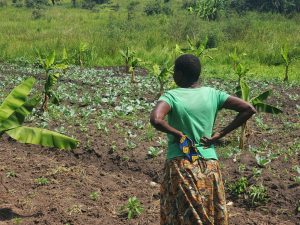
“I can’t afford irrigation to support my garden, so I spray SuperGro to support my vegetables. It provides moisture to them so that they don’t dry.” She explains.
Super Gro is a liquid organic agricultural surfactant and crop booster that helps water and agricultural treatments penetrate soil and plants more effectively. While Bhishma is an organic herbal insect repellent designed to target and eliminate destructive crop pests.
Akello is using this method to help her preserve cabbage and green pepper from drying out, as there have been early dry spells in the sub-region.
“It is cheap because I don’t have money to use other measures.” She narrates.
In addition to using SuperGro, Akello is maintaining her soil fertility by using animal manure and chicken droppings collected from the poultry and goats she rears, alongside her crop farming.
“It is not labour-intensive; it is always reliable and cheap, and it has helped to improve the quality of my production.” Akello shares.
In other areas, farmers are using bottle irrigation and rain mulching as adaptive measures to climate change.
Eng. Anywar, as an agriculture climate-smart expert, urges rain-fed farmers to adapt to drought impacts by using the first rain.
“Let us prepare our gardens early and utilise the early rain, those who used the first rain, the ones harvesting maize now.” He notes.
This is part one of the story, done with support from Northern Uganda Media Club (NUMEC)